Home Depot shares tumbled Tuesday after the company once again cut its 2019 forecast, and also reported same-store sales well below estimates.
The company said revenue, which also missed analysts' targets, was hurt by investments it is making in its business. Earnings came in a penny better than expected.
Shares of Home Depot were down about 5% in premarket trading, putting it on pace for its worst day since Feb. 5, 2018, when the company lost 5.6%. Shares of rival Lowe's, which reports its earnings before the bell on Wednesday, were down nearly 2% before the market's open.
Here's what the company reported compared with what Wall Street was expecting, based on a survey of analysts by Refinitiv:
Earnings per share: $2.53, adjusted, vs. $2.52 expected
Revenue: $27.22 billion vs. $27.53 billion expected
Same-store sales growth, global: 3.6% vs. 4.7% expected
The company said the investments it's making in its business have hurt the timing of its sales. Home Depot has been spending money updating its stores and digital platform while also improving its supply chain.
"We are largely on track with these investments and have seen positive results, but some of the benefits anticipated for fiscal 2019 will take longer to realize than our initial assumptions," CEO Craig Menear said in the release.
Home Depot said earnings fell to $2.8 billion, or $2.53 per share, from $2.9 billion, or $2.51 per share, a year ago. Analysts had expected the company to earn $2.52 per share.
Sales increased 3.5% to $27.22 billion, just shy of analysts estimates of $27.53 billion.
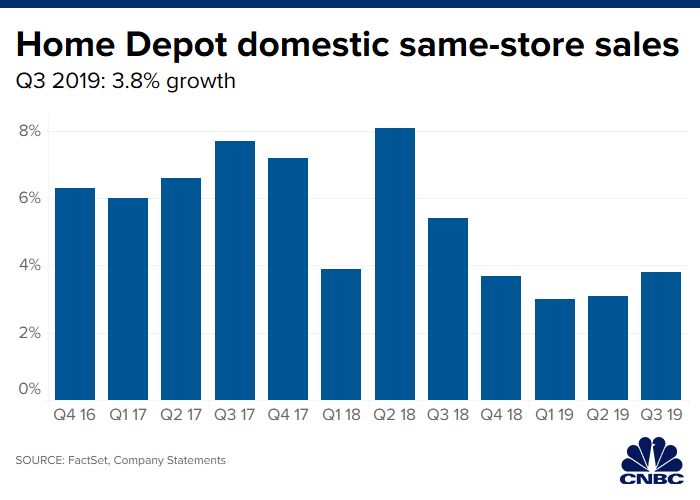
Sales at U.S. stores open at least 12 months rose 3.8%. Analysts were expecting a 4.7% gain.
Home Depot also cut its sales forecast for the year. It said it now expects sales to grow by 1.8%, down from a prior estimate of 2.3%. The company also cut its same-store sales forecast for the fiscal year. It now expects growth of 3.5%, compared with an earlier forecast of 4%.
Home Depot said its average customer ticket in the third quarter was $66.36, which was higher than it saw in the year ago quarter. Sales per square foot also rose to $449.17 from the year-ago period.
Last quarter, the Atlanta-based company trimmed its full-year revenue outlook, partially due to potential tariff impacts. It estimated the Dec. 15 tariffs and the 25% tariffs already in place could raise its cost of sales by about $2 billion, or about 2% of annual sales.
Home Depot CEO Craig Menear also cited continued lumber deflation for the lower sales forecast.
Rival Lowe's is slated to . Shares of Home Depot hit a 52-week high on Monday of $239.31. The stock, which is valued at $262 billion, has risen 39% as of Monday's close. Rival Lowe's, which has a market value of nearly $89 billion, has gained 24% year to date.
The week closes with all three major averages at record highs.
U.S. equity futures are indicating a higher open to trading on Tuesday, the day after another trio of records.
Continue Reading Below
The three major futures indexes are pointing to a gain of 0.4 percent, with the Dow adding 100 points..
All three major indexes opened the week by rising above the all-time highs they set on Friday. The S&P 500 rose 0.1 percent to 3,122.03. The Dow Jones Industrial Average also gained 0.1 percent to 28,036.22, and the Nasdaq composite climbed 0.1 percent to 8,549.94.
The Chinese Central Bankcut the seven-day reverse repurchase rate to 2.50 percent from 2.55 percent fueling expectations that Beijing will continue to ease monetary policies, accoridng to Reuters.
Chinese indexes were rising moderately despite the continuing unrest in Hong Kong. Police have tightened their blockade over Hong Kong Polytechnic University, where some protesters are trapped and hundreds who left have been arrested.
Police in riot gear move through a cloud of smoke as they detain a protester at the Hong Kong Polytechnic University in Hong Kong, Monday, Nov. 18, 2019. Hong Kong police fought off protesters with tear gas and batons Monday as they tried to break th
The U.S. market has been on a tear since early October, and indexes have been on a nearly uninterrupted run as worries about a possible recession have faded. Solid economic data, better corporate earnings than analysts expected and interest-rate cuts by the Federal Reserve have all helped.
That leaves negotiations in the U.S.-China trade war as the remaining wild card for the market. President Trump had earlier hoped to have signatures on the first phase of a trade deal by now, at a major international summit that was scheduled for this past weekend. But the president of the summit’s host nation, Chile, canceled the meeting last month amid nationwide protests.
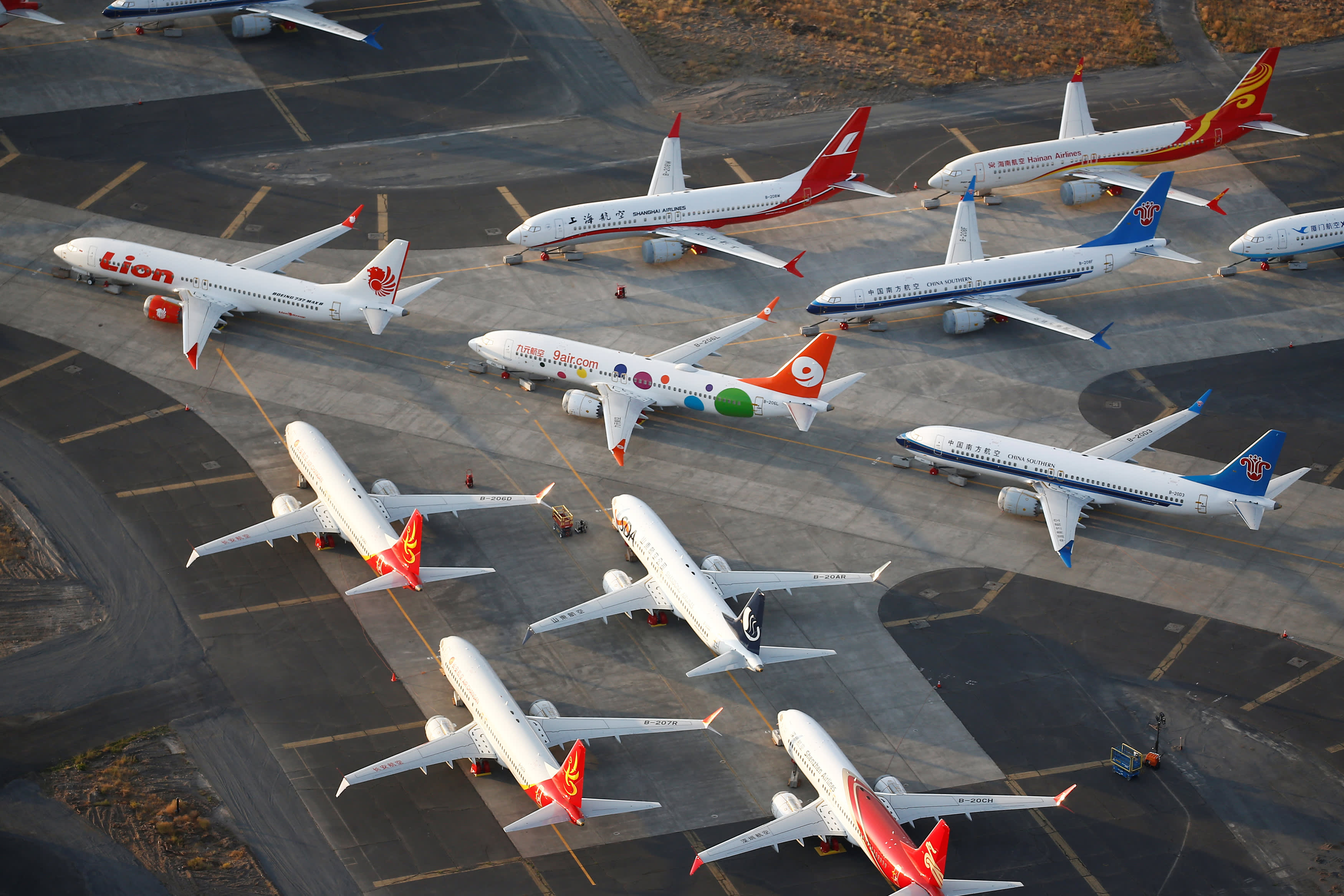
An aerial photo shows Boeing 737 MAX aircraft at Boeing facilities at the Grant County International Airport in Moses Lake, Washington, September 16, 2019.
Kazakhstan carrier Air Astana announced Tuesday a letter of intent for 30 of the Max jets, which have been grounded globally since March following two devastating crashes in the span of five months that killed 346 people.
The bid, which comes on top of a reported firm order from a mystery buyer for 20 of the Max jets, represents a vote of confidence for a plane whose dangerous defects triggered the largest crisis in the aviation industry this year.
Air Astana's commitment, valued at $3.6 billion, is not a firm order, and all of the deals of the last week remain subject to the aircraft receiving regulatory approval to return to service. The Kazakh airline is also a customer of Boeing's French rival Airbus, which has raked in massive deals this week and so far overshadowing those of the American plane-maker.
The Wall Street Journal on Tuesday reported 10 orders for Boeing's 737 MAX 7 and 10 for its 737 MAX 10 from an undisclosed buyer, citing people familiar with the matter.
Tuesday's news follows an increased order for the Max 737 8 jets from Turkey-based airline SunExpress, which added a firm order for 10 of the planes, worth $1.2 billion at list prices, in addition to a previous order of 32. A steep discount is typically negotiated by airlines.
The announcements mark a win for Boeing, but its total of $5.6 billion in orders so far pales in comparison to the tally of Airbus, which has so far inked around $30 billion in orders at list prices. Europe's largest aerospace company on Monday won orders for 120 of its A320neo jets from Air Arabia and 50 of its A350s from Dubai flagship carrier Emirates, valued at approximately $14 billion and $16 billion, respectively.
Ahead of the confirmation of its Airbus order, Air Arabia was reportedly in talks with Boeing as recently as two weeks before the show.
The Dubai Air Show, known for record-breaking mega deals, typically sees fierce competition for deals from rivals Airbus and Boeing, who each own approximately half of the market for large commercial airliners. But the American plane-maker's presence has been subdued thus far, weighed down by the crashes, ensuing safety concerns and the grounding of its fleet of roughly 400 jets around the world.
The aerospace giant has struggled this year, with new orders all but drying up as a result. British Airways parent, International Consolidated Airline Group, said during the Paris Air Show in June that it intends to buy 200 of the 737 Max planes, but that order has not been firmed up.
DUBAI (Reuters) - Boeing’s 737 MAX took center stage at the Dubai Airshow on Tuesday as the U.S. planemaker prepared to announce orders for dozens of aircraft as it seeks to restore confidence in the jet amid a worldwide grounding, people familiar with the matter said.
FILE PHOTO: An aerial photo shows Boeing 737 MAX aircraft at Boeing facilities at the Grant County International Airport in Moses Lake, Washington, September 16, 2019. REUTERS/Lindsey Wasson /File Photo
Boeing was expected to announce the orders, which could be worth $5-6 billion, a day after securing the first firm order for the aircraft since the grounding from Turkey’s SunExpress.
Global regulators banned commercial flights of Boeing’s fastest-selling jet in March after two fatal accidents.
Boeing is in the process of modifying software and pilot training which will require regulatory approvals.
In other news, budget airline easyJet exercised the purchase rights to order 12 more Airbus A320neo aircraft, Airbus said on Tuesday.
Airbus is also prepared to unveil an order for 8 of its small A220 jets from Air Senegal, delegates said.
Also coinciding with the show, leasing giant GECAS was expected to confirm an order for 25 Airbus jets including 12 A330neo powered by engines from Rolls-Royce, a competitor to GECAS parent company General Electric.
However, there were no immediate signs that Dubai’s Emirates was ready to finalize a provisional order for 40 Boeing 787 Dreamliners, part of a complex set of interlocking deals driving fleet changes at the world’s largest international airline.
The fate of the order hinges on negotiations over the larger Boeing 777X for which Emirates is the largest customer. Emirates has indicted it wants to restructure the order following delays and sources say it could use the pending 787 deal as leverage.
(This story has been refiled to add missing word “said”, paragraph 1)
Reporting by Tim Hepher; editing by Shri Navaratnam and Jason Neely
Airbus has won $30bn (£23bn) worth of orders for 170 aircraft in another sign of the continued expansion of Middle East airlines.
On the second day of the Dubai Air Show, Emirates announced the purchase of 50 Airbus A350-900 XWBs - extra wide body - planes at a list price of $16bn.
That was closely followed by fast-growing low-cost carrier Air Arabia ordering 170 Airbus A320s worth $14bn.
The European aircraft manufacturer makes its wings in the UK.
Both airlines are likely to get a discount on the catalogue price, given the size of the orders.
Air Arabia chief executive Adel Ali told reporters the aircraft order was a "game-changer" for the airline. He said it would allow Air Arabia to expand in southeast Asia and Africa.
Meanwhile, Emirates said its order, announced at a hastily-convened news conference after last-minute negotiations, will be used to help re-shape its fleet as the airline adjusts to a slowing regional market and the early end to production of the A380 super-jumbo jet.
Emirates is the biggest operator of the A380, with more than 100 of the aircraft in its fleet.
The airline's chairman and chief executive, Sheikh Ahmed bin Saeed Al Maktoum, said the A350s would allow Emirates to expand its long-haul network. The first of the A350 aircraft, which flies up to 15 hours and carries 350 passengers, will be delivered in 2023.
"It is very good news for Airbus," the European aerospace giant's chief executive, Guillaume Faury, told the news conference. He added that there would be no reversal of the decision earlier this year to end production of the A380.
Emirates said the airline was still in talks with Airbus rival Boeing about buying more aircraft from the US manufacturer.
Sheikh Ahmed said talks were continuing with Boeing at the air show, with everything up for discussion, including when the US aerospace giant might resolve issues around its 737 Max, currently grounded after two crashes.
Emirates has previously said it could buy 40 of Boeing's 787 Dreamliners, but has yet to firm up the order.
ROMULUS, Mich. (Reuters) - Long before the pistons for General Motors Co V-6 engines reach the U.S. No. 1 automaker’s Romulus, Michigan plant, they are seasoned international travelers.
A partially assembled V6 engine, used in a variety of General Motors cars, trucks and crossovers, moves down the assembly line at the GM Romulus Powertrain plant in Romulus, Michigan, U.S. August 21, 2019. Picture taken August 21, 2019. Rebecca Cook
Powdered aluminum from Tennessee is shipped to Pennsylvania and forged at high temperatures into connecting rods for the pistons, which are then sent to Canada to be shaped and polished. They are then shipped to Mexico for sub-assembly and finally the finished pistons are loaded onto trucks bound for Romulus to become part of a GM V-6 engine.
The parts make four international border crossings in all, without a single tariff levied.
“They already have their passports,” said Jim Bovenzi, GM’s executive director of global supply chain on a recent tour of the Romulus plant. “We look at North America as a borderless region. We have parts and components coming back and forth across the border all the time.”
GM’s V-6 engine is just one example of how GM and rivals Ford Motor Co and Fiat Chrysler Automobiles NV have used the 25-year-old North American Free Trade Agreement (NAFTA) to shift work to lower-cost facilities across the continent, cutting expenses and boosting returns from the region that represents the bulk of their global profits.
U.S. President Donald Trump now seeks to replace NAFTA with the new United States-Mexico-Canada Agreement (USMCA), signed by the countries’ leaders last November, which he says will boost American jobs.
U.S. automakers have lobbied hard for the new treaty to preserve NAFTA’s effective lack of borders, and say they can work with it because it does just that.
However, if Trump follows through on his repeated threats to pull the United States out of NAFTA if the U.S. Congress does not ratify USMCA, automakers would be forced to pay a patchwork of tariffs under World Trade Organization rules.
That would destroy the cost advantages of their cross-border supply chains - which include U.S. companies employing American workers - and would likely force automakers to redesign their manufacturing models and find cheaper alternatives elsewhere, industry experts say.
The uncertainty means automakers and manufacturers are holding off on key investments.
“A lot of our production is very, very capital intensive and when you’re deploying that much capital you want to have a clear sense of what the rules are,” said Everett Eissenstat, GM’s vice president for global public policy. “It’s quite important for us to get those (USMCA) rules in place so we can have some stability and predictability to continue to produce and invest here in the United States.”
U.S. business investments fell 3% in the third quarter and 1% in the second quarter, due to concerns over mounting trade tensions, including the issue of NAFTA and tariffs worldwide.
“Businesses are already becoming more cautious about investments,” said Michael Gregory, head of U.S. economics at BMO Capital Markets. “If we get to the point where the administration is actively talking about tearing up NAFTA, I think that would trump any concern about China.”
Democrats, who are pushing for more labor and environmental protections in the new treaty, say they are making progress toward passing USMCA in 2019. But if that does not happen, it risks being postponed in 2020 ahead of the next presidential election, which would mean an extended period of uncertainty.
JOURNEY OF A PISTON
GM’s Romulus Powertrain plant makes about 400,000 V-6 engines a year for high-margin Cadillac SUVs, light pickup trucks and other GM vehicles
The pistons that end their long journey there are only a small part of the 70-plus trucks bearing parts such as engine blocks or cylinder heads, that arrive there daily.
The Romulus-built V-6 uses 235 parts from 100 primary suppliers. Sixty-seven ship from factories in the United States, 13 from Mexico, 8 from Canada and 12 from elsewhere in the world. Most of the electronics come from Asia.
All told, GM spends $71 billion a year on materials, sourcing 133,000 different parts from 3,100 primary suppliers.
At Romulus, five trucks daily carrying 288 100-pound (45 kg) engine blocks - the heart of the V-6 engine - each come from either a GM casting operation in Saginaw, Michigan, or a supplier in Mexico.
The Mexican parts are cheaper, GM’s Bovenzi said, but using dual suppliers reduces the risk of relying on one plant for a critical part like the engine block.
The more labor intensive it is to make, the more likely a part is sourced from Mexico, according to James Rubenstein, a professor of geography at Oxford, Ohio-based Miami University who has studied the automobile industry and NAFTA.
“Final assembly costs don’t affect the overall cost of a vehicle that much,” he said. “Focusing on labor-intensive parts further down the chain is what really makes a difference.”
MARRIAGE OF PARTS
When the V-6 engines - now weighing around 500 pounds - are unloaded at GM’s Spring Hill plant near Nashville, an even bigger marriage of components takes place.
As individually labeled V-6 engines move down the line - for Cadillacs and Acadias - about 200 parts from 88 different suppliers are attached. Fifty-eight are American, 12 Mexican, 5 Canadian and 13 from elsewhere.
Spring Hill workers install an automatic transmission from a GM plant in San Luis Potosi, Mexico, a starter and generator made in Tennessee by Japanese supplier Denso Corp, an air conditioning compressor made by Denso in Michigan, a drive belt made by Gates Industrial Corp Plc in Mexico, tensioners and a pulley made by Gates in Canada, converters made in Tennessee by Tenneco Inc and battery cables from China.
Ford and Fiat Chrysler, alongside other major automakers like Japan’s Toyota Motor Corp and Nissan Motor Co, have all built up similar international supply chains to support their North American assembly operations.
The lower costs achieved by such diverse sourcing means better margins on higher-priced vehicles like the Cadillac XT6. The SUV retails for $55,490, almost $20,000 above the average U.S. new car price, and is one of GM’s higher-margin vehicles.
The use of lower-cost countries for more labor intensive parts is now “part of the recipe to compete in the global market,” said Kristin Dziczek, vice president of industry, labor and economics at the Center for Automotive Research (CAR) in Michigan.
European automakers, for instance, have similarly moved production of parts to cheaper, tariff-free countries within the European Union.
Tearing up NAFTA or imposing tariffs would hurt U.S. automakers’ competitiveness, according to Dziczek.
CAR estimated in June that the average price of a U.S.-made vehicle would rise $1,100 if Trump carried out his threat of levying tariffs of up to 25% on Mexican imports over illegal immigration.
Slideshow (19 Images)
North American tariffs would force automakers to move sourcing of lower-cost parts from Mexico to other cheap markets like Vietnam, Dziczek said.
That would be bad for Mexican suppliers, but would also hurt U.S. suppliers and defeat Trump’s aim to boost U.S. jobs, as shuttling parts back and forth between Asia and the United States would not be cost effective.
“If we weren’t getting it from Mexico, we’d be getting it from somebody else’s ‘Mexico’,” Dziczek said. “And the further away that ‘Mexico’ is, the less likely it is American suppliers would benefit from that business.”
Reporting By Nick Carey in Romulus, Michigan; Editing by Joseph White and Bill Rigby
Elon Musk tweeted his welcome to Ford's new electric vehicle, the Mustang Mach-E SUV.
More and more conventional automakers have been breaking into the electric vehicle market, tapping into the market which Tesla has sought to dominate.
Ford unveiled its new Tesla rival the Mustang Mach-E SUV on Sunday with great ceremony — featuring an appearance from actor Idris Elba. The car costs between $43,895 and $60,000, and includes various Tesla-like features such as a front trunk (or "frunk") and keyless activation where owners can start their cars using an app on their smartphone.
Ford Motor Co. shows the all-new electric Mustang Mach-E vehicle for a photo shoot at a studio in Warren, MichiganReuters
Musk responded to the unveiling via his favorite medium of Twitter. "Congratulations on the Mach E! Sustainable/electric cars are the future!! Excited to see this announcement from Ford, as it will encourage other carmakers to go electric too," he tweeted on Sunday.
Congratulations on the Mach E! Sustainable/electric cars are the future!! Excited to see this announcement from Ford, as it will encourage other carmakers to go electric too.
This isn't the first big play Ford has made in the electric vehicle market. The company announced in October it was giving electric vehicle owners two years of free access to its network of 12,000 charging stations in North America. Notably Ford's charging points are useable by any vehicle, whereas Tesla's Supercharger network