Johnson & Johnson faced lawsuits from at least 103,300 people or entities in U.S. courts at the middle of this year.
Photo:
mark ralston/Agence France-Presse/Getty Images
Johnson & Johnson,
JNJ 1.76%
facing lawsuits from more than 100,000 plaintiffs over its product safety and marketing tactics, has taken the aggressive strategy of battling many of the cases in court.
And it is losing. A lot.
Juries and judges have ordered the health-products giant to pay billions of dollars in several recent trials over claims that J&J’s signature baby powder and certain drugs and medical devices injured people, and that its marketing practices fueled the opioid-addiction epidemic.
The latest: A Philadelphia jury last week awarded $8 billion in punitive damages to a man claiming his use of J&J’s antipsychotic Risperdal when he was a boy caused abnormal breast enlargement. J&J says it properly disclosed the drug’s risks and benefits, and plans to appeal the verdict.
In August, an Oklahoma judge ordered J&J to pay $572 million to the state for contributing to the opioid-addiction crisis, a judgment the company is appealing. Last year, a St. Louis jury found that J&J should pay $4.7 billion to 22 women and their families who alleged the company’s baby powder caused ovarian cancer. J&J, which says the talcum powder is safe and doesn’t cause cancer, is appealing the decision.
The New Brunswick, N.J., company faced lawsuits from at least 103,300 people or entities in U.S. courts at the middle of this year, up from the 8,580 plaintiffs pending in October 2011, according to a Wall Street Journal review of J&J’s securities filings. J&J discloses the number of plaintiffs for the most significant of its product-liability cases in its filings.
The number of talc lawsuit plaintiffs surged to 15,500 as of June 30, from 1,400 in early 2016, the Journal analysis found. Plaintiffs in personal-injury lawsuits over J&J’s pelvic mesh devices for women have declined from a peak of more than 55,000 pending in 2017 but still number about 24,800.
J&J is challenging many of the lawsuits, rather than quickly settling, according to lawyers on both sides. “Their natural reflex is to fight and delay, drag it out as long as they can,” said Andy Birchfield, an attorney with Beasley Allen in Montgomery, Ala., who has sued J&J over baby powder and other products.
The Risperdal damages and some other awards are likely to be reduced by judges, and possibly overturned, on appeal. Yet the losses signal J&J may ultimately have to pay a costly sum to resolve the lawsuits. The opioid litigation alone could cost J&J $5 billion to $10 billion to settle, Wells Fargo analysts have estimated.
J&J has won its share of trials. The company argues science supports the safety of its products, and that its increasing caseload is a product of aggressive plaintiff’s lawyers eyeing the company’s big pockets. It is in the company’s best interest, its outside lawyers say, to deter more lawsuits lacking merit by avoiding premature settlements now.
J&J is approaching the litigation “with an eye to managing this onslaught overall, and not creating false incentives for lawyers to file even more claims that are marginal at best,” said John Beisner, a partner with Skadden, Arps, Slate, Meagher & Flom LLP who is defending J&J in litigation over talc and some other products.
J&J may be following in the footsteps of
Merck
& Co., which took to trial a number of lawsuits alleging its Vioxx painkiller caused heart attacks and strokes, said Nora Freeman Engstrom, a law professor at Stanford Law School who studies personal-injury litigation.
Merck won more verdicts than it lost, and ultimately agreed in 2007 to settle nearly all of the lawsuits for $4.85 billion, lower than analysts initially expected. Yet a key difference, Ms. Engstrom said, is that J&J is battling litigation on a large scale for multiple products.
Concerns about J&J’s litigation risk have weighed on its stock, which is down about 12% since its 52-week high in December. Some analysts say the slide reflects investors’ expectations that J&J may have to spend from $20 billion to $50 billion to resolve all of the litigation. J&J had $81.6 billion in revenue last year.
In August, Moody’s Investors Service changed its outlook for J&J’s bond rating to negative from stable, citing uncertainty over the outcome of litigation.
Eye-catching verdicts also are hurting the company’s reputation for trustworthiness, amassed from decades of careful marketing to parents and its famous handling of a Tylenol scare. Recent legal losses have dropped J&J to 57th out of 58 companies in a pharmaceutical reputation index developed by Alva Group, which bases its scores on mentions in the news, social media and analyst reports. J&J was in the index’s top 10 in 2014.
A J&J spokesman said the company’s reputation remains strong because it has developed high-quality consumer products and treatments for cancer and HIV. He said the company’s victories at trial and reversals of losses on appeal don’t garner the same level of attention as high-dollar trial losses.
Some lawyers say the longer litigation continues, the easier the cases become for plaintiffs to win because more documentation is unearthed and plaintiffs’ lawyers can refine their strategies based on earlier trials.
“The cases only get better for plaintiffs, not worse,” said Richard Golomb, a Philadelphia attorney representing women who have sued over J&J’s baby powder.
J&J, however, has a reason for holding out on a large talc settlement. It has asked a federal judge in New Jersey overseeing pretrial proceedings for a majority of the talc suits to exclude testimony from the plaintiffs’ expert witnesses who claim talc causes cancer. Plaintiffs’ lawyers say the testimony should be allowed.
If the judge sides with J&J, it could effectively wipe out most of the talc lawsuits; a decision is expected in the coming months.
LONDON (Reuters) - A global index of stock markets slipped on Monday as signs of progress in the China-U.S. trade dispute drew mixed a reaction from investors, with some cautioning over a lack of detail in the initial stages of the agreement.
Stock markets in Asia cheered U.S. President Donald Trump's outlining the first phase of an agreement to end a trade war with China and suspending a threatened tariff hike, but European shares slipped.
The pan-European STOXX 600 index () was down 0.75% in early trade in London.
Germany's DAX (), dominated by companies exposed to China, slipped 0.5%. All European country indexes were in the red.
MSCI's All-Country World Index, which tracks shares across 47 countries, was down 0.06% on the day.
The emerging trade deal, covering agriculture, currency and some aspects of intellectual-property protection, would represent the biggest step by the two countries in 15 months. But investors advised caution.
"While a positive development, we are not absolutely certain that this marks the start of a clear de-escalation of the trade dispute," said Mark Haefele, chief investment officer at UBS Global Wealth Management. A number of issues were unresolved or unclear, in his view.
"A delay to the scheduled December tariffs was not announced, although that's likely if a deal is reached, and the state of provisions on intellectual property, forced technology transfer, and Chinese state subsidies, the most difficult aspects of the negotiations, are still unclear."
Contributing to the gingerly reception of phase 1 of the trade agreement were data showing a further contraction of Chinese exports and imports in September. Liquidity was also lacking with Japan off and a partial market holiday in the United States for Columbus Day.
Australia's main index gained 0.54% () and South Korea () rose 1.11%. Shanghai blue chips () added 1%.
E-Mini futures for the S&P 500 were down 0.2% after rising on Friday.
The drag from the trade war was a major reason Singapore's central bank eased monetary policy on Monday for the first time in three years. Data showed the city-state's economy had only narrowly dodged recession.
BIG WEEK FOR BREXIT
The progress on trade was still enough to hit safe-haven bonds. Yields on U.S. rose to 1.7530%.
The yield curve also steepened as short-term rates were held down by news the Federal Reserve would start buying about $60 billion per month in Treasury bills to ensure "ample reserves" in the banking system.
The fading rally in risk assets as European markets opened saw the Japanese yen regain ground against the dollar. The currency was 0.2% higher to the dollar at 108.22 .
The dollar gained 0.2% against a basket of currencies.
Sterling fell to $1.2556 , retreating from a 15-week high of $1.2708 on Friday on optimism Britain could reach a deal on Brexit with the European Union. However, both British and EU officials said on Sunday more work would be needed to secure an agreement.
More talks will be held on Monday before a summit of EU leaders in Brussels on Thursday and Friday.
gained 0.05%, last trading at $1,490.20 per ounce.
Oil prices pared gains made on Friday after reports that an Iranian state-owned oil tanker had been attacked in the Red Sea.
Investors were also watching Turkey's incursion into Syria as the White House threatened to impose sanctions on Ankara.
futures eased 1.14% to $59.82 a barrel. lost 1.04% to $54.13 a barrel.
An estimated 44.5 million retired workers receive monthly income in the form of Social Security benefits. If you work and pay Social Security taxes, then chances are, those benefits will be an important source of income for you once your career comes to an end. But if you rely on those benefits too heavily and neglect your savings as a result, you may be in for an unpleasant reality check as soon as your golden years kick off.
Currently, 50% of married seniors and 70% of unmarried seniors get 50% or more of their income from Social Security, while for 21% of married seniors and 45% of unmarried retirees, those benefits represent 90% or more of their income. But when we look at how much money that actually translates into, it's easy to see why Social Security alone isn't enough to sustain the typical senior.
IMAGE SOURCE: GETTY IMAGES.
The average retiree on Social Security today collects $1,471 a month, or $17,652 a year. Meanwhile, the average senior aged 65 and over spends $46,000 a year on living expenses, reports the Bureau of Labor Statistics. Clearly, there's a pretty wide gap between those two numbers, and it's for this reason that planning to live on Social Security alone in retirement is a truly bad idea. If that's your intent, consider this your wakeup call to start building savings and come up with a backup plan.
What will your expenses look like in retirement?
Many people expect their living costs to drop dramatically once they retire, but many seniors don't see all that substantial a decline. And when we think about the things seniors generally spend money on, that makes sense.
Seniors require housing, transportation, food, clothing, utilities, and modest forms of leisure, like cable TV, just like working folks do. Furthermore, retirees tend to face higher healthcare costs than workers, especially when we consider the various out-of-pocket expenses associated with Medicare. And that's why most seniors can't get by on just 40% of their former income, which is what Social Security is designed to pay the average earner. Retirement just plain costs too much money.
The solution? Save as much as you can while you're working. If you start out young, you can get away with contributing smaller amounts to a retirement savings plan and growing your balance with the right investments. If you're already older, you'll need to make more sizable contributions to build a solid level of savings.
Check out the following table, which illustrates how your savings efforts might pan out, depending on the window of time you have to work with and the amount of money you sock away in a retirement plan each month:
Age You Start Saving
Monthly Retirement Plan Contribution
Total Savings by Age 65 (Assumes a 7% Average Annual Return)
30
$400
$663,000
35
$500
$567,000
40
$600
$455,000
45
$700
$344,000
50
$800
$241,000
CALCULATIONS BY AUTHOR.
The less time you give yourself to sock away funds for retirement, the less wealth you stand to amass. In our table, increasing monthly contributions doesn't help compensate for delayed savings. That's because by putting off your savings, you miss out on years of critical investment growth. And if you're wondering about the 7% return used above, it's actually a couple of percentage points below the stock market's average yearly performance.
Of course, building savings isn't the only way to supplement your Social Security benefits. You can also get a part-time job in retirement or monetize a hobby. In fact, your retirement income can come from a variety of sources. Just make sure your plan is not to have all of it come from Social Security.
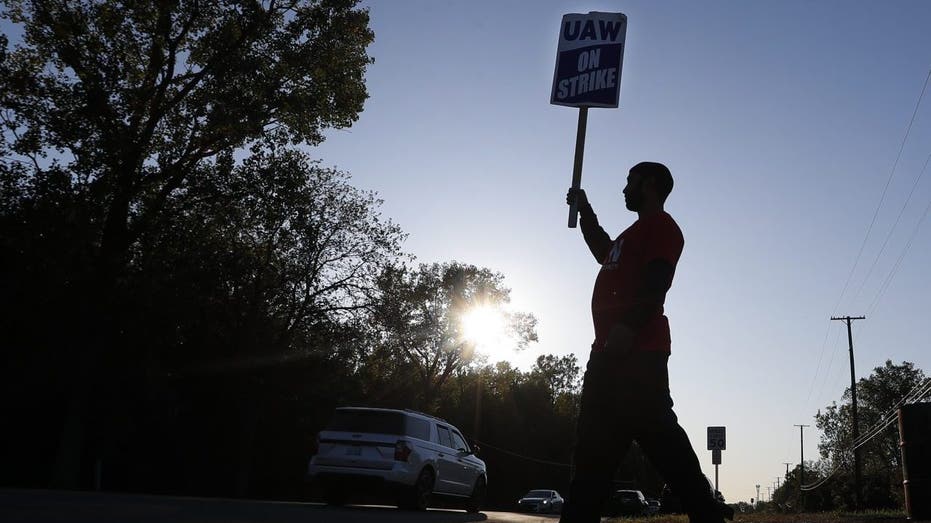
Rep. Bill Huizenga (R-MI) discusses the current state of the General Motors strike and its impact on the economy.
The United Auto Workers board voted on Saturday to bump up workers' strike pay by $25 a week and allow them to take part-time jobs and still qualify for the benefit.
Continue Reading Below
The decision comes as the UAW's nationwide strike against General Motors is a few days away from its one-month mark.
Starting on Sunday, workers who perform picket duty will get $275 a week in strike pay. Strike pay was $250 a week and was already set to rise to $275 in 2020.
"UAW members and their families are sacrificing for all of us," union president Gary Jones said in a statement. "We are all standing together for our future. This action reflects the UAW commitment and solidarity to all of our members and their families who are taking a courageous stand together to protect our middle-class way of life."
A member of the United Auto Workers walks the picket line at the General Motors Romulus Powertrain plant in Romulus, Mich., Wednesday, Oct. 9, 2019. (AP Photo/Paul Sancya)
The looser standards will also apply to UAW-represented Aramark janitorial employees who work at GM facilities and walked off the job a day before autoworkers did the same.
Previously, if workers performed outside work earning more than $250 a week, they forfeited the strike pay. Those workers still qualified for specified health care benefits available through the UAW Strike and Defense Fund.
Elon Musk shared new details about SpaceX's planned Mars-capable crewed launch system, called Starship, on September 28.
SpaceX is developing and launching Starship prototypes next to Boca Chica Village, a small neighborhood of retiree-age residents in South Texas.
Citing concerns about safety and disruptions, the rocket company recently offered to buy out everyone's homes in the area. But most residents initially balked at the deal.
While he was in town for his highly anticipated talk, Musk, the founder and CEO of SpaceX, met privately with some of the residents.
Villagers who attended the meeting described it as "awkward," "tense," and "heated," but ultimately productive in that they felt Musk — and SpaceX — listened to their complaints.
Hours after fans cheered him on-stage in South Texas, Elon Musk walked into a morass: a private meeting with perturbed locals whose properties that SpaceX, the rocket company Musk founded, had recently offered to buy out.
Residents say Musk attentively listened to their concerns and squashed some of their fears about the buyout process. But they described their roughly half-hour encounter with the tech mogul as "awkward," "tense," "heated," "confused," and "exhausting" — though it ended with handshakes, selfies, and some sense of progress.
Musk heard out his tough audience just before midnight on Saturday, September 28, during a visit to Boca Chica. The remote strip of land is located at the southeastern tip of the state, and it's where SpaceX is building a private launch site and spaceport.
But it's also where about 20 retiree-age residents live in the formerly sleepy residential neighborhood of Boca Chica Village, some of them for decades.
"We weren't playing nice with him. We made it clear we were not happy," said one resident to Business Insider. The person attended the private meeting but asked not to be named.
Why Musk met with villagers in southeastern Texas
A prototype of SpaceX's Starship, called Mk 1, rocket is seen at the company's South Texas launch facility in Boca Chica on September 28, 2019. Future versions of Starship are designed to be massive enough to take people to the moon, Mars, and beyond.
Loren Elliott/Getty Images
Musk's main task for the trip was delivering a highly anticipated update on SpaceX's plans for a next-generation rocket system, called Starship.
"The critical breakthrough that's needed for us to become a space-faring civilization is to make space travel like air travel," Musk said during his presentation while standing before a 16-story steel prototype.
Critical to making such a breakthrough, though, is room to safely build, test, and launch such Starship prototypes — vehicles which Musk has said last year might explode (though this is a risky reality of any rocket-test program). SpaceX has mostly used Boca Chica for this work, and Musk's presentation, which featured a new Starship launch visualization showing off big plans for the coastal site, underscored the company's hopes for its nascent spaceport.
"I think it's definitely possible that the first crewed mission on Starship could leave from Boca [Chica]," Musk said.
However, SpaceX has set up its rocket skunkworks close to residents' homes. The company built its launch pad just 1 1/2 miles from properties on the eastern edge of the community — twice as close as NASA permitted spectators to get to its space shuttles in Florida.
An overview of the Boca Chica area in south Texas circa 2017.
Google Earth
"[I]t has become clear that expansion of spaceflight activities as well as compliance with Federal Aviation Administration and other public safety regulations will make it increasingly more challenging to minimize disruption to residents of the Village," the company's cover letter said.
A prototype of SpaceX's Starship vehicle is pictured behind a home in Boca Chica Village, Texas, on September 28, 2019. SpaceX is attempting to buy out the residents of this community in order to expand spaceflight activities.
Loren Elliott/Getty ImagesBut SpaceX's seemingly generous pitch — three times an appraised value for each home — alarmed many if not most residents.
Some told Business Insider that they planned to permanently retire in the area and weren't interested in moving.
Nearly everyone had concerns about the offer's base appraisals, claiming they were abnormally low, and thus even a three-fold offer wouldn't come close to paying for a comparable coastal home in South Texas. (Some residents described the appraisals as "lowball" and "drive-by," since they did not evaluate the interior of homes.
Residents also told Business Insider that property comparisons, which were used to inform value, relied on properties that SpaceX purchased under duress, as well as suburban homes in Brownsville that didn't compare to their bucolic coastal setting.)
Some who wanted to stay said they feared a eminent domain process led by Cameron County, in which Boca Chica is based, may eventually force them out to make way for SpaceX's out-of-this-world ambitions.
With tensions peaking and Musk in town, SpaceX decided to put their CEO and a cadre of residents into a room to work things out.
SpaceX stopped one resident from trying to record the meeting. But according to interviews with five people who were in the room, here's what happened.
Residents said at first they 'felt like we'd been set up'
Elon Musk unveiled the 164-foot-tall Starship Mark 1 prototype in Boca Chica, Texas, on September 28, 2019.
SpaceX/YouTube
Days before Musk's Starship presentation, SpaceX invited village residents to come. Around 10 people RSVP'd, and SpaceX picked them up with a shuttle. Helping corral and greet everyone was a senior legal counsel for the company from Washington, DC, as well as a government and business-affairs liaison who worked on-site in Boca Chica.
The last shuttle drove into SpaceX's work yard compound shortly before 8 p.m., where workers had finished assembling a 16-story prototype of Starship's spaceship the day before. Residents say their handlers directed them to a sandbagged area just a few yards to the left of a small riser, which Musk stepped onto and spoke for about 40 minutes.
Immediately after he walked off-stage, SpaceX cued the residents to head to the shuttle, which they expected to drop them off at their homes less than a mile away. But once everyone had boarded, SpaceX invited the residents to join them at Stargate: a two-story technology park funded by the University of Texas Rio Grande Valley facility (which SpaceX uses as a launch control center).
"They turned around and said, 'Well, we're going to take you over here to the Stargate, upstairs, and we're going to have a special guest come meet you there,'" said Patricia Mitchell, who's owned a home in the village since 2005 with her husband, Walter.
SpaceX workers rush to and from UTRGV's Stargate facility to a launchpad during tests.
Dave Mosher/Business InsiderThey arrived to a spread of wine, beer, cookies, chips, and other snacks. The group got comfortable on couches, chairs, and stools awaiting their "special guest," whom they could only presume was Musk.
As the residents were settling in at Stargate, Musk returned to the stage at SpaceX's work yard to take questions from media. Christian Davenport of The Washington Post asked about SpaceX's long-term plans for the Boca Chica site.
"It will definitely get fancier than it currently is. The reason it's not fancier is because it would have taken too long to build the buildings," Musk said. "I think it will be a lot more buildings and a lot more stuff. Way more stuff than is currently here."
An illustration of SpaceX's planned 39-story-tall Starship rocket system at a launch site in Boca Chica, Texas.
SpaceX/YouTube
Later on, Jeff Foust of Space News asked about the future of residents in light of the FAA's apparent safety concerns.
"We're going to make sure that the risks to the public is extremely, vanishingly small. Almost nothing, basically," Musk said. "I don't see any fundamental obstacles. We are working with the residents of Boca Chica Village because we think oh, it's time, it's going to be quite disruptive to their — to living in Boca Chica Village. Because it'll end up needing to get cleared for safety a lot of times."
He added: "I think the actual danger to Boca Chica Village is low but is not tiny. So therefore we want super-tiny risk. Probably over time, [it's] better to buy out the villagers. And we've made an offer to that effect."
Most residents in the room at Stargate didn't learn about the Q&A or Musk's comments — the clearest yet from the company regarding the villagers' futures — until just before 11 p.m.
"We would have rather been down there or streaming. We just weren't savvy enough," said Maria Pointer, who was there with her husband, Ray.
"Everybody felt like we'd been set up," Walter Mitchell said. "We had questions we wanted to ask right there and have media exposure."
As some residents in the room played back streaming video of the Q&A session, agitated at having missed the remarks — and at being in their second hour of waiting for Musk — SpaceX's senior legal counsel addressed the room. She announced that Musk would arrive in about 15 to 20 minutes, noting that anyone who needed to leave could be driven home. She also opened the floor to concerns or questions to pass along.
"She invited a dialogue at that time," one resident said of the moment. "And suddenly everyone wants to unload on her."
Residents began heatedly questioning the "non-negotiable" wording in their buyout offers. They also brought up what some described to Business Insider as an "aggressive" two-week deadline to accept the deal, as well as what seemingly everyone felt was an undervaluation of their properties.
"We all felt that deadline, and three times, and 'not negotiable' — we felt that was a threat," Walter Mitchell said.
As the complaints petered out, a few residents left. One person forgot her pain medication, and her husband followed her out. Another left from exhaustion. Silence came over the room just before Musk walked in, which was sometime around 11:20 p.m.
'Nobody knew how to talk to this guy'
SpaceX CEO Elon Musk gives an update on the next-generation Starship spacecraft at the company's Texas launch facility on September 28, 2019 in Boca Chica near Brownsville, Texas.
Loren Elliott/Getty ImagesMusk arrived with an entourage of about five or six people, and immediately walked up to the residents, most of whom were sitting in a small semicircle of chairs and a couch. Everyone stood up, and Musk shook their hands, then he started speaking about why SpaceX picked Boca Chica to be the company's private spaceport.
"He talked about the regulations in Florida and why it was better for them to be here rather than in Florida, because things could get done a bit faster," Mr. Pointer said.
After a few minutes of opening remarks, Musk paused and there was a brief pause.
"It was pretty awkward. Nobody knew how to talk to this guy," Mrs. Pointer said. "You could tell people were feeling excited or flattered."
But Mr. Pointer apparently broke the silence. In an interview with Business Insider, he said he wasted little time expressing to Musk how he thought the appraisals and SpaceX's buyout offer process generally was unfair.
"I said I thought it was unconscionable that we were having to see ourselves — in so many words — dispossessed with a short-notice letter and the sword of Damocles over our heads concerning eminent domain. Those aren't my exact words, but that's certainly what I wanted to get out," Mr. Pointer said. "And then the Mitchells chimed in with their feelings about that as well — similar feelings — and then everyone started going at it."
The Mitchells explained how the offer they received for their property, which the couple planned to pass down to their children, wouldn't buy them a somewhat comparable setup in nearby South Padre Island, the nearest beachside real-estate market (though a much hotter one as a popular tourist destination).
"He was very polite and listened to what we had to say on that matter," Mr. Pointer said. "He just absorbed it and waited for the next blow."
When someone brought up the "non-negotiable" issue with the buyout offer letter, Musk chimed in with an edit.
"He goes, 'It's negotiable.' And everyone goes, 'It is negotiable?'" Mrs. Pointer said. "It surprised us and floored us."
While the three-fold number was not negotiable to be fair to everyone, Musk apparently explained, SpaceX would consider new appraisals that addressed residents' concerns. Shortly after that, two residents said they asked about eminent domain and whether or not those who chose to stay would eventually be forced out for reasons of safety or convenience.
"He said that he didn't want to do that, that's not what he wanted to do," Mr. Pointer said. "But that's not an answer to the question."
Two other residents allegedly said that they "didn't mind" SpaceX's presence and inquired about staying, according to others in the room. (One of residents previously described himself to Business Insider as "the biggest SpaceX fan in Texas," so much so that he moved to Boca Chica in 2015 to retire amid the company's launch site.)
Residents brought up a community meeting SpaceX held in 2015, not too long after the company had broken ground on its launch site. According to residents, officials allegedly said the company would — during temporary launch evacuations under a previous (and now-abandoned) plan — house residents in hotels in Brownsville, about 20 miles west of Boca Chica.
Walter Mitchell made himself clear: "There are people here that want to keep their property," Mitchell said he told Musk. "I said, 'You guys said in that meeting that you would take us and put us in hotels.' I said, 'Can that work? And they can keep their property?'"
"Well, if they don't mind frequent shuttles to a hotel frequently, we could probably do that," Musk responded according to Mitchell.
Residents also brought up other grievances and needs: a request for soundproof windows, a more courteous and helpful on-site contact with the company, and more transparency from the company about its activities.
Free Teslas and selfies
After airing their complaints and feeling heard by Musk, residents told Business Insider the "heated" and "exhausting" mood of the room began to change. That shift appears to have happened when the Mitchells cracked a joke: Could Musk throw a free Tesla electric car into everyone's buyout offer?
"We started laughing, almost all of us," a resident said, though Musk then explained that even as CEO he is required to buy his own vehicles from the company.
From there, residents said the previously "heated" conversation shuffled between a mix of joking and technical explanations. The SpaceX fan struck up a conversation about metals used in Starship. Musk apparently also described a long-term plan to move away from land-based launch pads and instead use offshore platforms near Boca Chica Beach to fly Starship with less risk to the ground.
"He mentioned that they have to take off right offshore, but they have to land somewhere, right? And you can't do that on land in the middle of Paris, I think he said," Mrs. Pointer recalled. "So you have to have offshore facilities everywhere."
As the conversation loosened up a bit more, an aide called an end to the meeting.
"He shook everyone's hand, and at the end of it, everyone took selfies," Mr. Pointer said of Musk (though he noted that he himself did not).
'I don't think we were supposed to live next to a rocket ship yard'
Maria Pointer looks on from her front yard in Boca Chica, Texas, as SpaceX workers assemble a prototype of a spaceship called Starship Mark 1 next door on September 27, 2019.
Jonathan Newton/The Washington Post via Getty Images
Residents returned home after midnight and began to soak in what had transpired.
"I don't feel like I'm on the dark side of the moon as much as I was before," Mrs. Pointer said. "I feel like they are seriously learning where all the fault lines were, where all the gaps were, where things were just falling through because they move so fast, and we don't move that fast."
Residents say SpaceX has not only extended its buyout offer deadlines, but also dispatched an appraiser to more fully evaluate their homes and consider properties in coastal areas. If those assessments come back with a more fair valuation, multiple residents who initially said they'd decline the deal told Business Insider they would reconsider selling to SpaceX.
But some residents say they still feel doubtful and pained about their futures. For instance, the Pointers have invested years of work into their Boca Chica property to make it a customized and comfortable retirement homestead, not just a winter home or Airbnb (as some residents use their properties).
"I appreciate where he's going. I understand the Mars thing — I got it — and I'm happy with everyone going forward with that. I think that's an important thing to do; he's doing a good thing, and that's fine," Mr. Pointer said. "But as far as I'm concerned — for me? — he's ruining my life and my situation out here. That being said, I just have to move on under the circumstances."
Mrs. Pointer later added: "I just don't think this is our life. I don't think we were supposed to live next to a rocket ship yard."
SpaceX did not return multiple requests comment for this story ahead of its publication.
“Don’t rely on Social Security”: because inflation adjustments are punitively low, and benefits become more inadequate as you age.
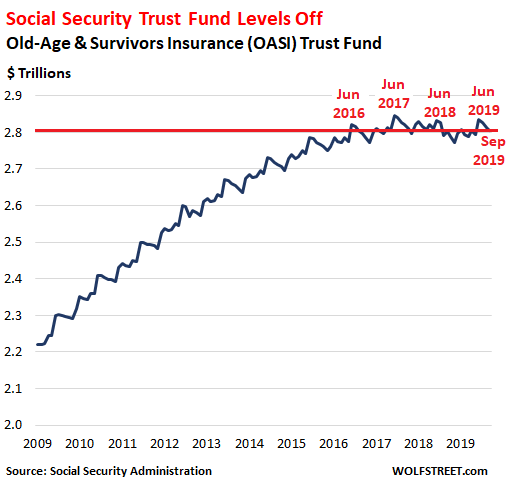
The Old-Age and Survivors Insurance (OASI) Trust Fund – does not include the Disability Insurance (DI) Trust Fund – which closed the fiscal year 2019 at the end of September with a balance of $2.80 trillion, according to figures released by the Social Security Administration. This balance was up by $3 billion from September last year, but was down $16 billion from September 2017.
The balance tends to hit annual peaks in June. The all-time peak was in June 2017, at $2.846 trillion. In June 2018, the balance was down by $13 billion. In June 2019, the balance, at $2.834 trillion, was up $1 billion from a year earlier, but was still down $12 billion from the peak in June 2017. You get the drift: 2017 was a record year, 2018 was an alarming down-year, and 2019 has reversed the down-trend, but not by much:
The Social Security Trust Fund is benefiting from the increase of workers – particularly millennials, the largest generation ever – and from rising wages that trigger higher Social Security deductions. And the date when the trust fund is depleted keeps getting moved out further, currently estimated to occur in 2034.
Depletion of the Trust Fund doesn’t mean that Social Security will collapse or whatever. It means either that workers will have to pay in a little more, or benefits will get cut, or a little of both. Social Security has been fixed before. Raising the maximum amount of earning subject to Social Security tax would be one way of doing it.
Over 63 million retirees are drawing Social Security benefits (in addition, 8 million people are drawing SSI disability benefits).
Back when I was a senior in high school, the dad of my sweetheart told me that Social Security was a “scam” and that it wouldn’t be around for him to use when he’d retire. He was a CPA and had his own business, an accounting and tax firm. He ended up retiring and collecting Social Security, which was still around. And a few years ago, he passed away, and his wife began collecting survivor benefits. Social security, which has been around for 84 years, has outlived him, and it’s going to outlive me too.
But he gave me a piece of wise and correct advice – for the wrong reason: “Don’t rely on Social Security.” It’s tough to live off Social Security benefits, and it gets much tougher as you get older, as we’ll see in a moment.
Of the SS Trust Fund’s assets, almost all, $2.79 trillion, were invested in in long-term US Treasury bonds at the end of September, with a weighted average maturity of 7.8 years. The remaining $12 billion (less than half of 1% of the total) were invested in short-term “certificates of indebtedness,” similar to Treasury bills.
US Treasury securities are considered among the most conservative assets. The fund’s investment in Treasuries is very similar to a bond fund’s or a regular pension fund’s investment in Treasuries. The funds receive interest payments and are paid face value by the Treasury Department when the security matures.
But there is one difference: Bond funds, pension funds, and other investors buy “marketable” Treasury securities that can be traded in the bond market. The SS Trust Fund buys nonmarketable Treasuries that cannot be traded, which has an advantage: Since they cannot be traded, their value doesn’t change on a daily basis. The Trust Fund accounts for them at face value, and face value is what the Trust Fund gets paid when the securities mature.
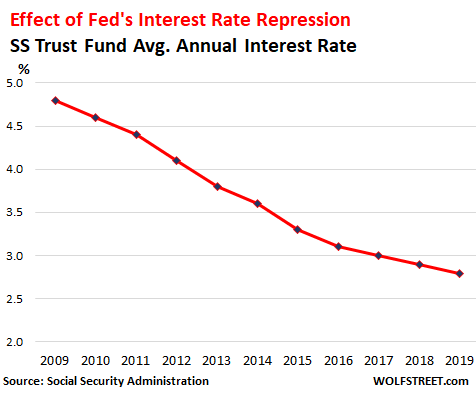
In September, the weighted average interest rate of the securities in the Trust Fund fell to 2.73%, the lowest in my lifetime. The average annual interest rate for each year has been declining relentlessly since 2009, dropping from 4.8% in 2009 to 2.8% in the fiscal year 2019:
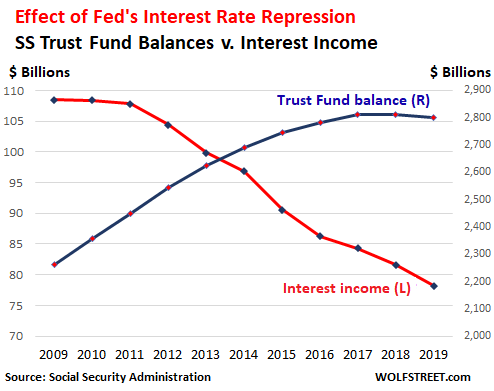
This means that despite rising balances in the SS Trust Fund, interest income has plunged. Trust Fund balances rose 24% from 2009 through 2019. But interest income fell 28% over the same period, from about $108 billion in 2009 to $78 billion in 2019. The chart below shows average weighted annual interest income (declining red line, left scale) versus Trust Fund balances (right column):
This decline of interest income speeds up the deterioration of the Trust Fund. At current Trust Fund levels, each decline of 1 percentage point of the average annual interest rate slashes the Fund’s interest income by $28 billion a year.
And interest income will fall further as securities that were acquired years ago at higher interest rates are replaced with securities bearing much lower interest rates.
Punitively low Cost of Living (COLA) adjustments.
Benefits in 2020 will increase by just 1.6% for the year, starting in January 2020, the Social Security Administration announced on Thursday.
Social Security benefits are adjusted for inflation based on the Bureau of Labor Statistics’ inflation measure for “urban wage earners and clerical workers” (CPI-W). The fundamental problem is that CPI does not measure changes in the costs of living. It measures changes in prices of the same thing or service at the same quality over time. And when quality of goods (such as electronics or car) or service (such as housing) improves, the BLS removes the cost of these improvements form the index.
In other words, CPI only measures the loss of purchasing power of the dollar, and purposefully does not measure the costs of quality improvements.
This produces a situation where over the past 20 years, the CPI for new vehicles has been flat, even as actual retail prices have soared, as the cars have gotten a lot better, such as going from two air bags to 10 air bags, and from a 4-speed automatic transmission to an 8-speed automatic transmission, etc. Here is my detailed discussion on these “hedonic quality adjustments” for new vehicles and how they relate to CPI.
But it is impossible today to buy these products or services without the quality improvements, and therefore retirees have to pay more even if they don’t want those quality improvements.
The 1.6% increase in benefits doesn’t include the increases in prices due to quality improvements. It just compensates for the loss of purchasing power of the dollar (price changes of the same thing at the same quality). That’s one massive issue with the COLA adjustments.
Another massive issue with the COLA adjustments is that the basket of goods and services used by an elderly person is different from the goods and services used by the average urban worker. For example, the average elderly person has much greater healthcare needs than the average worker. And healthcare expenses have far outrun the Consumer Price Index.
The inadequate COLAs are transpiring every year, year-after-year, and for retirees who’re dependent on Social Security, which is already tough to live on at the beginning, face a gradual and pernicious reduction of the standard of living they’re able to pay for.
This is why my high school sweetheart’s dad was right, but for the wrong reason, and yes, dear millennials, that’s for you: Don’t rely on Social Security, not because it won’t be there for you (it will be), but because the COLAs are purposefully insufficient once you draw benefits, and the benefits will become more and more inadequate as you age.
Enjoy reading WOLF STREET and want to support it? Using ad blockers – I totally get why – but want to support the site? You can donate “beer money.” I appreciate it immensely. Click on the beer mug to find out how:
Would you like to be notified via email when WOLF STREET publishes a new article? Sign up here.