Jumat, 19 Juli 2019

As 'superstar' cities keep winning, worrisome U.S. divide widens - Reuters

NASHVILLE, Tenn. (Reuters) - In the depths of the financial crisis, when the world was shunning debt and battening down for the worst, city officials here zagged in what seemed a preposterous direction and spent $600 million on a new convention center.

The downtown district is pictured in Nashville, Tennessee, U.S., January 7, 2019. Picture taken on January 7, 2019. REUTERS/Howard Schneider

A decade later thousands of new hotel rooms soar over the site, including a 33-story Marriott that is just a tiny part of the investment and jobs boom that has made Nashville an envy of other cities trying to find their footing, an image cemented when Amazon announced it would put a 5,000-job logistics center here.

“Look at the skyline, see the activity - whether it is a Monday night or a Saturday night - the city is thriving,” said Tom Turner, president of the Nashville Downtown Partnership.

It is in many ways a positive story of how new winners can emerge even after a devastating recession. But it also represents a major fault line in the recovery that followed: Winning places like Nashville have won big, often for reasons that can’t obviously or quickly be replicated, while much of the rest of the country has struggled to stay even or slipped behind.

It is a schism that helped elevate Donald Trump to the presidency with his massive support in less populated and slower-growing areas. The divide is also preoccupying U.S. central bankers and economists worried about what happens if large portions of the country never bounce back.

“The superstar cities have pulled so far away,” said MIT economist Simon Johnson. He recently called for a $100 billion annual federal investment in basic research centered in cities like Rochester, New York, that have the base of universities and college graduates to compete as innovation hubs.

“There is no entity other than the federal government that has the capacity to move the needle on this.”

WHERE THE GROWTH IS ... AND ISN’T

The U.S. economy entered a second decade of growth this month, marking the longest expansion on record.

In many ways the country has seemingly recovered from a 2007-2009 recession that was the worst downturn since the 1930s. Unemployment is near a 50-year low, household income has been rising, and the country is at a point in the business cycle when workers typically see their most robust gains.

But a Reuters analysis of federal data shows just how unevenly the spoils of growth have been divided.

In a ranking of 378 metropolitan areas by how their share of national employment changed from 2010 to 2017, 40% of the new jobs generated during that time went to the top 20 places, along with a similar share of the additional wages.

Those cities represent only about a quarter of the country’s population and are concentrated in the fast-growing southern and coastal states. None were in the northeast, and only two were in the “rust belt” interior - Grand Rapids, Michigan, and a rebounding Detroit.

Nashville ranked 11th on the list, keeping company with other southern towns like Charlotte and Atlanta, and the usual fast-growth suspects like Seattle and San Francisco.

The drop from there is steep. The next set of 20 cities captured about 10% of the jobs created from 2010 through 2017, close to their roughly 7.5% share of the population.

At the bottom, 251 cities, many spread across the heartland and in the industrial northeast, lost job share.

It is a map that hews close to Trump’s election results: Of 221 counties that voted for President Barack Obama in 2012 and Trump in 2016, only three are in the metropolitan areas that won the most job share. Sixty-two are part of metro areas where the share of national employment declined.

MUSIC CITY MIRACLE? OR HAPPY ACCIDENT?

Among the decade’s winners, many have an obvious story to tell - Houston as a long-time oil town amid a boom in U.S. energy production or San Francisco as the epicenter of all things tech.

But interviews with entrepreneurs and officials in Nashville point to a mix of factors behind its success, including some that were out of the city’s control, such as the state’s lack of an income tax, and others associated with its unique local assets.

The once-in-a-generation decision to gamble on the convention center shows the importance of political leadership, something Federal Reserve officials and economists have begun to see as central to a local jurisdiction’s success. But it also depended on the city’s celebrated country music roots and seven-night-a-week year-round party scene as the draw for major conferences and trade shows, something that can’t simply be reproduced by other municipalities.

With rock-bottom interest rates and companies competing aggressively for building work, “you could never build at that price again,” said Turner of the convention center. “It gave the city a different way of looking at things. Coming out of the recession you had new momentum.”

For some cities, the presence of legacy companies positioned in growth industries like healthcare can give a boost. But for others, whose anchor firms may have been in industries that have fled overseas, such as textiles, the hill is harder to climb.

Private sector jobs in Nashville surged 31% since national employment bottomed in 2010, from 622,000 to around 820,000 through 2017, double the national job growth rate of around 15%, according to federal data.

The 40 top job-generating metro areas saw employment expand 23% during those years. Jobs in other metro areas grew around 11%, and in counties outside of metro areas the job growth rate was around 4.5%.

WHAT’S LUCK GOT TO DO WITH IT?

And there are quirks of history. Nashville’s downtown zoning rules had been notoriously strict. When they were eased in the 1990s, the result was fast growth from a low base, as builders turned empty land into new neighborhoods.

It came off as a boom, but in fact it was more “playing catch up” after years of underbuilding, said Jay Turner, whose MarketStreet Enterprises developed the now trendy Gulch neighborhood around an abandoned rail yard.

Jay Turner, who is not related to Tom Turner, said Nashville “was underdeveloped because of the zoning” that had put a premium on offices and parking garages.

That type of surge can only happen once, and not at all in cities that are already filled in.

Turner said it created a dynamic where “people say we need exposure in Nashville.”

Fed officials are taking the gap in economic outcomes among cities and regions seriously. Providing time for “catch up” among lagging demographic groups and areas of the country is one of the reasons behind policymakers’ decision to leave interest rates low and to consider cutting them in coming weeks.

Atlanta Federal Reserve bank president Raphael Bostic has made the issue a priority in his travels and research, puzzling over why places in his district like Atlanta have surged ahead while others have not.

Slideshow (3 Images)

It’s not clear, he said, that there’s a uniform policy mix that could easily spread the wealth.

“Every city has its unique narrative as to why it got to where it got,” Bostic said. “I don’t think there is a general formula that if you hit each point at a certain level you guarantee an outcome.”

Reporting by Howard Schneider; Editing by Dan Burns and Andrea Ricci

Let's block ads! (Why?)


https://www.reuters.com/article/us-usa-economy-nashville-insight/as-superstar-cities-keep-winning-worrisome-u-s-divide-widens-idUSKCN1UE13B

2019-07-19 10:16:00Z
CBMiiwFodHRwczovL3d3dy5yZXV0ZXJzLmNvbS9hcnRpY2xlL3VzLXVzYS1lY29ub215LW5hc2h2aWxsZS1pbnNpZ2h0L2FzLXN1cGVyc3Rhci1jaXRpZXMta2VlcC13aW5uaW5nLXdvcnJpc29tZS11LXMtZGl2aWRlLXdpZGVucy1pZFVTS0NOMVVFMTNC0gE0aHR0cHM6Ly9tb2JpbGUucmV1dGVycy5jb20vYXJ0aWNsZS9hbXAvaWRVU0tDTjFVRTEzQg

Netflix CEO Reed Hastings may have missed the real reason why U.S. subscriber numbers plunged - MarketWatch

New research on how consumers react when they don’t know what to watch on their video-streaming service could help explain why Netflix is losing subscribers.

Netflix’s NFLX, -10.27% second-quarter earnings report Wednesday revealed fewer new subscribers than expected. But Nielsen’s analysis on viewing habits might help explain what consumers have been doing if they haven’t been buying Netflix subscriptions of late.

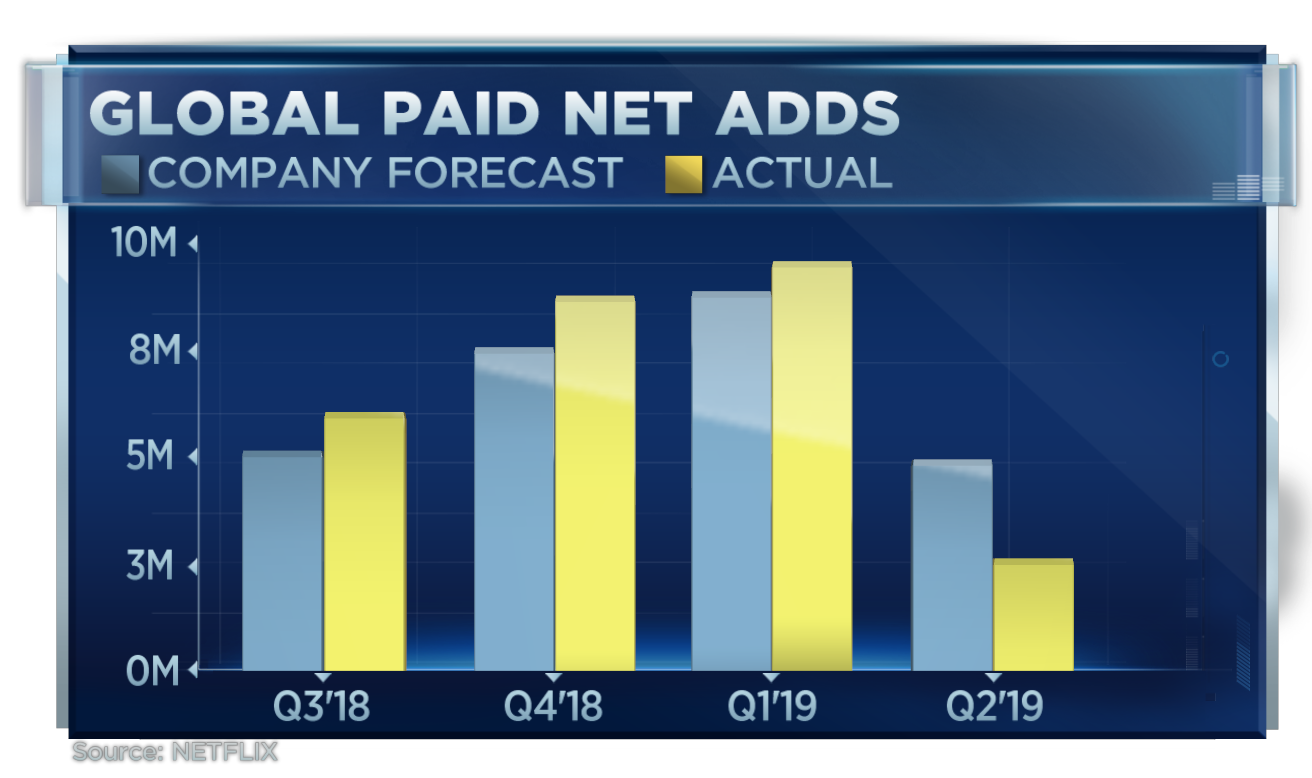
The company said it added 2.7 million subscribers across the globe in the second quarter. The company had predicted it would add nearly twice that (5 million subscribers) and analysts were disappointed. The company also lost 126,000 subscribers in the U.S. in the second quarter, the first such loss since 2011

That sent Netflix’s stock tumbling. Netflix shares dropped more than 10% Thursday. (Netflix did not respond to a request for comment on this story.)

“We think Q2’s content slate drove less growth in paid net adds than we anticipated,” Netflix executives said in a letter to shareholders this week. Netflix CEO Reed Hastings said that would be a focus in the third quarter, and said the third series of “Stranger Things” had already broken records.

Some 40.7 million household accounts have been watching the show since its July 4 global launch, the company said on Twitter TWTR, -0.11%  — “more than any other film or series in its first four days. And 18.2 million have already finished the entire season.”

But Nielsen has another, perhaps more troubling, theory that goes beyond other streaming competition from shows on Hulu, Disney DIS, -0.66% CBS CBS, -2.08%  and Amazon: When there’s just too much video streaming content to choose from, viewers turn to a trusty old friend: broadcast television.

If video streaming subscribers don’t know what they want to watch, they’re almost twice as likely to tune into their favorite broadcast television channel (58%) rather than browse through the menus of their streaming services (33%), according to the research from Nielsen.

Streaming service recommendations do not appear to carry much weight either — 44% of polled viewers said they would scan through television channels to decide what to watch, while 26% said they watch shows recommended by their subscription service.

When viewers are indecisive, the preference for television is stronger within the 35 to 49-year-old demographic, compared to viewers between the ages of 18 and 34.

Subscriptions like Netflix and Amazon Prime offer plenty of critically-acclaimed, award-winning content. But the thing is, viewers have to pick which movies and series they’ll watch, and observers say many are getting burned out from all that decision-making.

In addition to its rotating library of existing feature movies and TV shows like “Friends,” Netflix has ramped up creation of its own content, releasing some 1,500 hours of original series and movies in 2018, by one estimate. Viewers between age 18 and 34 spent 9.4 minutes browsing through content. Viewers age 35 to 49 spent 8.4 minutes.

Research by behavioral psychologists has shown that too many choices can overwhelm consumers, create the unpleasant feeling known as “decision fatigue” and sometimes leading them to shut down and walk away from a potential purchase.

Television viewers also need to choose what channel to watch. Yet part of the allure might be how television just beams whatever’s on the channel instead presenting viewers with even more options on what to watch.

2018 marked the first time ever that there were online video subscriptions than cable subscriptions across the country, according to the Motion Picture Association of America. There were 613.3 million streaming subscriptions globally, and 556 million cable television subscriptions, the organization said.

Video streaming is an increasingly crowded business. Apart from Hulu, CBS’s streaming service and Amazon Prime, there’s also HBO Now and Sling TV to name a few. Disney’s service, Disney Plus, will launch in November, and Apple’s AAPL, +1.14% own service is scheduled to go live later this year, though there’s no exact date yet. AT&T T, -0.51% which owns HBO, is also planning to launch HBO Max this spring.

Netflix shares are up more than 20% year to date, compared to a 16% gain for the Dow Jones Industrial Average DJIA, +0.01% and a 19% increase for the S&P 500 SPX, +0.36%

Let's block ads! (Why?)


https://www.marketwatch.com/story/why-too-much-content-could-be-hurting-netflixs-subscriber-numbers-2019-07-19

2019-07-19 11:05:00Z
52780334572016

Netflix CEO Reed Hastings may have missed the real reason why U.S. subscriber numbers plunged - MarketWatch

New research on how consumers react when they don’t know what to watch on their video-streaming service could help explain why Netflix is losing subscribers.

Netflix’s NFLX, -10.27% second-quarter earnings report Wednesday revealed fewer new subscribers than expected. But Nielsen’s analysis on viewing habits might help explain what consumers have been doing if they haven’t been buying Netflix subscriptions of late.

The company said it added 2.7 million subscribers across the globe in the second quarter. The company had predicted it would add nearly twice that (5 million subscribers) and analysts were disappointed. The company also lost 126,000 subscribers in the U.S. in the second quarter, the first such loss since 2011

That sent Netflix’s stock tumbling. Netflix shares dropped more than 10% Thursday. (Netflix did not respond to a request for comment on this story.)

“We think Q2’s content slate drove less growth in paid net adds than we anticipated,” Netflix executives said in a letter to shareholders this week. Netflix CEO Reed Hastings said that would be a focus in the third quarter, and said the third series of “Stranger Things” had already broken records.

Some 40.7 million household accounts have been watching the show since its July 4 global launch, the company said on Twitter TWTR, -0.11%  — “more than any other film or series in its first four days. And 18.2 million have already finished the entire season.”

But Nielsen has another, perhaps more troubling, theory that goes beyond other streaming competition from shows on Hulu, Disney DIS, -0.66% CBS CBS, -2.08%  and Amazon: When there’s just too much video streaming content to choose from, viewers turn to a trusty old friend: broadcast television.

If video streaming subscribers don’t know what they want to watch, they’re almost twice as likely to tune into their favorite broadcast television channel (58%) rather than browse through the menus of their streaming services (33%), according to the research from Nielsen.

Streaming service recommendations do not appear to carry much weight either — 44% of polled viewers said they would scan through television channels to decide what to watch, while 26% said they watch shows recommended by their subscription service.

When viewers are indecisive, the preference for television is stronger within the 35 to 49-year-old demographic, compared to viewers between the ages of 18 and 34.

Subscriptions like Netflix and Amazon Prime offer plenty of critically-acclaimed, award-winning content. But the thing is, viewers have to pick which movies and series they’ll watch, and observers say many are getting burned out from all that decision-making.

In addition to its rotating library of existing feature movies and TV shows like “Friends,” Netflix has ramped up creation of its own content, releasing some 1,500 hours of original series and movies in 2018, by one estimate. Viewers between age 18 and 34 spent 9.4 minutes browsing through content. Viewers age 35 to 49 spent 8.4 minutes.

Research by behavioral psychologists has shown that too many choices can overwhelm consumers, create the unpleasant feeling known as “decision fatigue” and sometimes leading them to shut down and walk away from a potential purchase.

Television viewers also need to choose what channel to watch. Yet part of the allure might be how television just beams whatever’s on the channel instead presenting viewers with even more options on what to watch.

2018 marked the first time ever that there were online video subscriptions than cable subscriptions across the country, according to the Motion Picture Association of America. There were 613.3 million streaming subscriptions globally, and 556 million cable television subscriptions, the organization said.

Video streaming is an increasingly crowded business. Apart from Hulu, CBS’s streaming service and Amazon Prime, there’s also HBO Now and Sling TV to name a few. Disney’s service, Disney Plus, will launch in November, and Apple’s AAPL, +1.14% own service is scheduled to go live later this year, though there’s no exact date yet. AT&T T, -0.51% which owns HBO, is also planning to launch HBO Max this spring.

Netflix shares are up more than 20% year to date, compared to a 16% gain for the Dow Jones Industrial Average DJIA, +0.01% and a 19% increase for the S&P 500 SPX, +0.36%

Let's block ads! (Why?)


https://www.marketwatch.com/story/why-too-much-content-could-be-hurting-netflixs-subscriber-numbers-2019-07-19

2019-07-19 09:38:00Z
52780334572016

Dow futures rally on hopes of aggressive easing from the Fed - CNBC

U.S. stock index futures continued to climb Friday morning after two influential Federal Reserve officials hinted at more aggressive policy easing from the central bank.

Around 5:15 a.m. ET, Dow futures implied a positive open of around 90 points, while S&P 500 and Nasdaq futures were also seen higher.

Stocks had been heading south on Thursday until New York Fed President John Williams said the central bank needed to "act quickly" when the economy was slowing and rates were low, adding in a speech that it is "better to take preventative measures than wait for disaster to unfold."

The S&P 500 reversed its trajectory to close 0.4% higher at 2,995.11, led by a 0.8% gain in consumer staples, while the Nasdaq and Dow Jones Industrial Average also finished the session marginally in positive territory..

However, a spokesperson for the New York Fed moved to cool the speculation arising from Williams' comments, telling CNBC that he was drawing from academic research, not hinting at potential policy actions at the upcoming Federal Open Market Committee (FOMC) meeting.

Investors on Thursday digested a mixed flurry of corporate earnings, as Netflix shares plummeted more than 10% after the streaming giant reported a surprise loss in U.S. subscribers, while Microsoft shares hit record highs after it beat analysts' estimates for fourth-quarter revenue and profit.

IBM reported its fourth consecutive revenue decline, while Morgan Stanley beat expectations.

American Express and BlackRock are among those reporting before the bell on Friday.

Investors will also be monitoring another escalation of tensions in the Middle East, after President Trump said a U.S. Navy ship destroyed an Iranian drone in a "defensive action" in the Strait of Hormuz.

—CNBC's Fred Imbert contributed to this report.

Follow CNBC International on and Facebook.

Let's block ads! (Why?)


https://www.cnbc.com/2019/07/19/us-stocks-dow-futures-aggressive-easing-fed.html

2019-07-19 06:18:27Z
52780335075090

Kamis, 18 Juli 2019

Here's why Netflix says it lost US paid subscribers for the first time in eight years - CNBC

Netflix Co-founder, Chairman & CEO Reed Hastings attends a Q&A during a Transatlantic Forum in Lille, France.

Sylvain Lefevre | Getty Images

Netflix blames its content slate, regional price increases and a "pull-forward effect" of its strong Q1 growth for its first quarterly loss of paid domestic subscribers since 2011.

The company on Wednesday reported a loss of 126,000 domestic paid subscribers compared with analysts' expectations for a 352,000 gain. Netflix also missed its own forecast for global subscriber growth by 2.3 million.

Its  shares plunged more than 11% Thursday.

The last time Netflix lost domestic subscribers was in 2011 after the company raised prices and tried to separate its streaming product from its DVD mailing service, sparking customer pushback.

Netflix said Wednesday its missed forecast was most pronounced in regions that saw price increases. The company said it does not believe competitive forces were to blame since "competitive intensity and our penetration varied across regions (while our over-forecast was in every region)."

Netflix said it will have a more robust content slate in the third quarter to attract more subscribers, forecasting 7 million paid net adds and revenue of $5.25 billion. The company said its TV show "Stranger Things" has already had strong viewership for its latest season, and it anticipates new seasons of "The Crown" and "Orange is the New Black" will be similarly popular.

Bernstein analyst Todd Juenger called the subscriber loss "the Q2 curse."

"There must be something about Q2 that makes it especially hard for Netflix to predict subs. Since 2016, they have missed their Q2 sub guidance three of four times," Juenger said in a note to investors Thursday.

While Netflix's subscriber loss in the U.S. is rare, its miss on international subscribers may be more troubling to investors since this represents its biggest growth opportunity. Netflix reported international net additions of 2.8 million subscribers compared with analyst estimates of 4.8 million.

Subscribe to CNBC on YouTube.

WATCH: Netflix's DVD business is still alive and profitable — here's what it looks like

Let's block ads! (Why?)


https://www.cnbc.com/2019/07/18/why-netflix-says-it-had-a-rare-subscriber-loss-in-q2-2019.html

2019-07-18 14:08:27Z
52780334572016

Toys R Us makes a small comeback with 2 stores - KSL.com

[unable to retrieve full-text content]

Toys R Us makes a small comeback with 2 stores  KSL.com

The first two new Toys R Us stores will open in November as part of a small comeback of the defunct iconic toy chain in the U.S..

View full coverage on Google News
https://www.ksl.com/article/46596943/toys-r-us-makes-a-small-comeback-with-2-stores

2019-07-18 13:08:32Z
CBMiU2h0dHBzOi8vd3d3LmtzbC5jb20vYXJ0aWNsZS80NjU5Njk0My90b3lzLXItdXMtbWFrZXMtYS1zbWFsbC1jb21lYmFjay13aXRoLTItc3RvcmVz0gEA

Old School Corvette Owners Already Hate The C8 - CarBuzz

Another comical complaint quoted from the article is from a 70-year-old retired accountant from New Jersey who says "I just don’t like the look of a short front end,” and concludes that he thinks the view from the driver's seat would make it feel like "driving a bus.” Curiously, this is not a complaint we've often had driving front-engined supercars that already exist from the likes of McLaren, Ferrari, and Lamborghini.

To hammer home how reactionary Corvette fans can be, WSJ then brings up Tom Peters, who led the exterior design for previous generations of the Corvette. He remembered the controversy when they dropped the pop-up headlamps, specifically the hate mail he got and how "We would go to these Corvette events and people wanted to get physical with me.”

WSJ also brings up the outrage from the purists when Porsche switched from using air-cooled engines to water-cooled engines. However, they neglect to mention the fact that Porsche and the 911 is doing just fine and the point of evolving sports cars is to actually evolve. If Chevy was to keep listening to the cigar-chomping Tommy Bahama wearing retirees that are stuck in the past, the Corvette simply wouldn't improve.

Let's block ads! (Why?)


https://carbuzz.com/news/old-school-corvette-owners-already-hate-the-c8

2019-07-18 11:54:58Z
52780335115604