Rabu, 15 Mei 2019

China's retail sales growth slumps to 16-year low as trade war risks rise - Investing.com

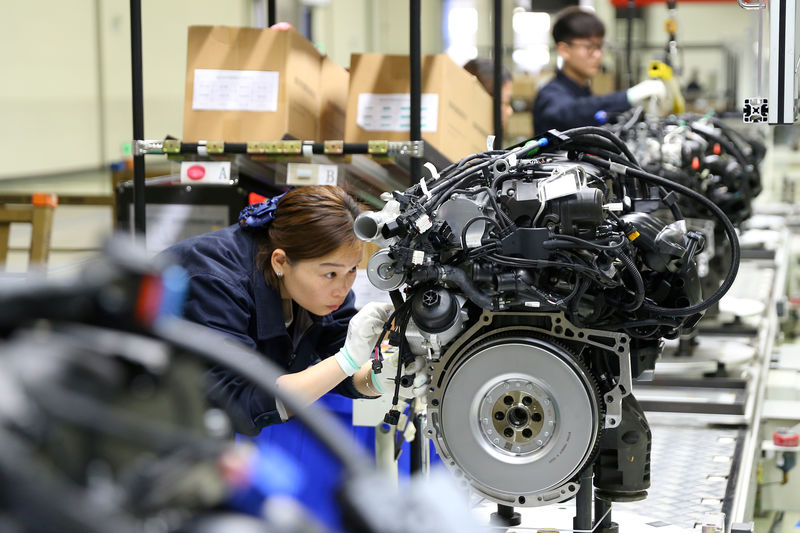
© Reuters. FILE PHOTO: Employees work on the production line at a factory of automotive engine manufacturer Power Xinchen in Mianyang © Reuters. FILE PHOTO: Employees work on the production line at a factory of automotive engine manufacturer Power Xinchen in Mianyang

By Kevin Yao and Yawen Chen

BEIJING (Reuters) - China reported surprisingly weaker growth in retail sales and industrial output for April on Wednesday, adding pressure on Beijing to roll out more stimulus as the trade war with the United States escalates.

Clothing sales fell for the first time since 2009, suggesting Chinese consumers were growing more worried about the economy even before a U.S. tariff hike on Friday heightened stress on the country's struggling exporters.

Overall retail sales in April rose 7.2% from a year earlier, the slowest pace since May 2003, data from the National Bureau of Statistics (NBS) showed. That undershot March's 8.7% and forecasts of 8.6%.

The data suggested consumers were now beginning to cut back spending on everyday products such as personal care and cosmetics, while continuing to shun more expensive items such as cars.

"Weak retail sales partially stemmed from a deterioration in employment and declining income of the middle-and-low income groups," said Nie Wen, an economist at Hwabao Trust.

"In terms of future policies to keep consumption as the stabilizer of the economy, China might roll out targeted tax cuts or subsidies to the middle-and-low income groups."

As a whole, Chinese data for April largely pointed to a loss of momentum, after surprisingly upbeat March readings had raised hopes the economy was slowly getting back onto firmer footing and would require less policy support.

Growth in industrial output slowed more than expected to 5.4% in April on-year, pulling back from a 4-1/2-year high of 8.5% in March, which some analysts had suspected was boosted by seasonal and temporary factors.

Analysts polled by Reuters had forecast output would grow 6.5%.

Motor vehicle production dropped nearly 16% as demand weakened, with sedan output slumping 18.8%, the steepest decline since September 2015. Industry data this week showed auto sales fell 14.6% in April, the 10th consecutive month of decline.

China's exports also unexpectedly shrank in April in the face of U.S. tariffs and weaker global demand, while new factory orders from at home and abroad remained sluggish.

"There are still uncertainties haunting the performance of the economy. Tensions between China and the U.S. have returned while concerns about insufficient demand worldwide are on the rise," Nie said.

Nie said China may need a more comprehensive cut in banks' reserve requirements in June before a G20 summit where Presidents Donald Trump and Xi Jinping are expected to discuss trade.

"The funding gap in the market is relatively large," Nie said, adding that smaller, more targeted reductions in bank reserves may no longer be enough to spur stronger growth.

There is relatively big room for policies to support growth, Liu Aihua, a spokeswoman at the statistics bureau, told reporters at a briefing, adding that employment is expected to remain steady.

The April nationwide survey-based jobless rate improved to 5.0% from 5.2% in March, though analysts are generally skeptical of Chinese employment data and see a rise in layoffs if export conditions deteriorate.

INVESTMENT

Adding to worries about domestic demand, Wednesday's data also showed an unexpected stumble in investment.

Fixed-asset investment growth slowed to 6.1% in the first four months of this year, dashing expectations for a slight rise to 6.4%.

Growth in infrastructure spending held steady at 4.4%, with a sharp slowdown in cement production possibly reflecting a slower-than-expected payoff from Beijing's efforts to fast-track road and rail projects.

China is trying to engineer a construction boom even as it steps up efforts to ease strains on smaller companies, ranging from tax cuts to financial incentives for firms which do not shed staff.

But private sector fixed-asset investment slowed sharply to 5.5% growth from 6.4%, suggesting the sector continues to face difficulties. The private sector accounts for the majority of jobs in China and about 60% of overall investment.

One of the few bright spots in the data was property investment, a key growth driver.

Real estate investment in April rose 12% from a year earlier, unchanged from March, according to Reuters calculations. But demand for new homes remained weak, weighing on sales of appliances and furniture.

TRADE TENSIONS

Washington dramatically escalated its 10-month tariff war with Beijing on Friday by raising levies on $200 billion of Chinese goods in the midst of trade talks, and Trump has threatened new levies on all remaining U.S. imports from China, sending global financial markets into a tailspin.

China retaliated on Monday, though on a smaller scale.

The two sides appear deadlocked in negotiations. But Trump softened his tone on Tuesday, insisting that talks between the world's two largest economies had not collapsed.

Economists at Citi estimate the U.S. tariff increase could lop 50 basis points off China's GDP growth, reduce exports by 2.7% and cost the country another 2.1 million jobs, though they are optimistic a trade deal will be reached eventually.

Analysts at BofA Merrill Lynch believe a prolonged period of brinkmanship would drag China's growth to 6.1% this year, from a near 30-year low of 6.6% in 2018.

They expect more policy easing in the short term, further cuts in banks' reserve requirements and another surge in bank lending, as well as consumer subsidies to boost sales of products such as cars, appliances and smartphones.

Some companies such as BMW have already lowered their prices after China cut the value-added tax (VAT) from April 1.

"We have full confidence in China's economic prospects," Geng Shuang, spokesman at the Chinese foreign ministry, said at a daily news briefing.

"U.S. protectionist and bullying actions will have some influences on the Chinese economy, but they can be completely overcome. If some people are not willing to do business with China, others will naturally fill this gap."

Let's block ads! (Why?)


https://www.investing.com/news/economic-indicators/china-april-industrial-output-up-54-much-less-than-expected-retail-sales-also-falter-1868352

2019-05-15 08:42:00Z
52780296866611

Bitcoin (BTC) Could Peak At $80,000 If Crypto’s Cyclicality Persists - Ethereum World News

Bitcoin Could Rally By 2,400% From The Bottom

As Bitcoin has returned over the past few days, many have been left asking where the cryptocurrency market could top. It may be a bit too early to tell, but some are that optimistic. Level’s Josh Rager notes that over Bitcoin’s three completed cycles, the trough to peak gains decreased by around 80% each time, which is a concept defined by the law of diminishing returns. As Rager notes, 2011’s rally saw a return of 320,000%; 2014, 58,500%; and 2017, 12,000%. Thus, if history is followed to a tee, BTC will rally by 2,400% off its bottom, giving it a potential high of just shy of $80,000, $78,500.

Higher Than $80,000?

Rager’s followers are under the belief that Bitcoin’s next top is going to be dramatically higher than $80,000. In a poll released prior to the tweet seen above, 43% of the 4,300 that responded expected highs of anywhere from $80,000 and beyond. Of course, this isn’t a majority, but it shows that there are many traders in this market that don’t expect for Bitcoin to follow historical trends of diminishing marginal returns to an exact tee.

Others have also speculated that the next peak in the cryptocurrency market will result in much higher prices for Bitcoin than $80,000. As Ethereum World News reported previously, Galaxy, claims that Bitcoin’s current monthly chart looks eerily similar to that seen in late-2015, when BTC finally began to embark on a rally yet again.

This is notable, as the last time BTC’s chart structure looked as it did now (a massive green candle after ~one year of selling pressure), what followed was a 6,500% price surge in a two-year time frame. Thus, Galaxy notes that if historical precedent is followed to a tee, a bull run of the previous one’s magnitude will place BTC at over $333,000 per unit by the end of 2021.

Funnily enough, he isn’t the notable analyst to have thought this. As reported by Ethereum World News in early-March, crypto personality $carface notes that if BTC continues to follow its multi-year trends of boom and bust, the asset could appreciate to $102,000 to $336,000 if it follows historical trends of rallying 5.1 to 16.89 times higher than its previous peak. Naeem Aslam, a crypto-friendly analyst at Think Markets, echoed this analysis, explaining that per his “simple maths calculation,” the leading digital asset trading at a hefty $400,000 isn’t a “fool’s paradise.”

And on the fundamental side, there are clear reasons why the cryptocurrency market could see another crazy move. As Filb Filb, a popular trader and researcher, explained in an extensive Twitter thread posted near December’s bottom, if BTC’s supply is issued on schedule, if crypto adoption follows that of the Internet’s, and if debt continues to increase, Bitcoin could easily see six figures by 2021, not decades down the line.

Moreover, some are sure that in the next couple of years and decades, Bitcoin will begin to absorb some of gold’s market capitalization, which sits at $8 trillion. An $8 trillion dollar Bitcoin, as Mark Yusko, speculates will give each coin the value of ~$500,000.

Title Image Courtesy of Marco Verch

Let's block ads! (Why?)


https://ethereumworldnews.com/bitcoin-btc-peak-80000-cryptos-cyclicality-persists/

2019-05-15 03:02:18Z
52780295272412

Selasa, 14 Mei 2019

Disney is taking full control of Hulu - CNN

Comcast on Tuesday agreed to sell its ownership stake in the streaming video service to Disney. The sale won't happen for at least another five years, but Disney will take full operational control of Hulu right now.
The deal is a sign of how much streaming video has changed in the last few years. Hulu was at one time a joint venture between several media titans: Disney (DIS), 21st Century Fox, Comcast's NBCUniversal and Time Warner (now WarnerMedia). None of those companies had majority control.
Now Hulu is effectively a Disney product. The company became the majority stakeholder in the streaming video service after it closed a deal for most of Fox's assets in March. Last month, WarnerMedia — now owned by AT&T (T)agreed to sell its 9.5% interest back to Hulu. (CNN is a division of WarnerMedia.)
Comcast (CMCSA) owns roughly a third of Hulu. Under the terms of the deal, Comcast will sell its interest to Disney for Hulu's fair market value no earlier than 2024. Disney has guaranteed that the sale price will reflect a minimum total equity value of $27.5 billion for Hulu at that time, according to a press release.
"Hulu represents the best of television," Disney CEO Bob Iger said in a statement, adding that the company is now able to "completely integrate" Hulu into its streaming plans in a way that makes the service "even more compelling and a greater value for consumers."
Disney has already made clear that Hulu will be a critical part of its streaming strategy. When the company debuted its Disney+ service to investors last month, it also spoke at length about the future of Hulu, which has more adult programming, like "The Handmaid's Tale."
Disney executives talked about potentially bundling its services together for a discounted price. They also said they want all of their services, including Hulu, to reach profitability within the next several years.
At $6.99 a month, Disney+ will start a streaming price war
"Hulu is the third leg of Disney's streaming strategy," said Trip Miller, a Disney shareholder and managing partner at Gullane Capital Partners. "Six months ago, you had four owners to the business and it was very complicated and confusing — so this brings about a lot of clarity and control of direction for Disney."
Right now, Hulu has roughly 27 million paid subscribers on its service. It still lags far beyond chief competitor Netflix, which has nearly 150 million subscribers globally, 60 million of whom are from the United States. Hulu is only available in the United States.
But Hulu is beefing up its original content offerings. Earlier this month, the streaming service showed off a slate of upcoming programs, including "The Dropout," a limited series about rise and fall of Theranos CEO Elizabeth Holmes. It's also working on two new live-action Marvel series, "Ghost Rider" and "Helstrom."
Hulu is going to need more programming as it prepares to eventually part ways with NBC content. Right now, Hulu carries a lot of NBC shows, including "Saturday Night Live," "The Voice" and "The Good Place." Comcast has agreed with Hulu to extend the service's license of NBCUniversal content through late 2024.
NBCUniversal can end most of its agreements with Hulu in three years. One year from now, NBC will have the right to carry some of the content it licenses to Hulu on its own streaming service, in return for reducing the fees Hulu pays to host that content.
"As Disney continues to grow their subscriber base, retaining Comcast/NBC Universal content is important," Miller said.
It's not a surprise that NBCUniversal would want to reserve some of its content for its own streaming service, which it said earlier this year would launch in 2020.
Several of the major media companies are pulling content from other streaming platforms so they can bulk up their own offerings. For example, Disney took a bunch of its shows and movies off of Netflix in preparation for the debut of the streaming service Disney+ later this year.
WarnerMedia and Netflix, meanwhile, reached an agreement to keep "Friends" on Netflix this year, but WarnerMedia reserved the right to put that show on its own forthcoming streaming service, if it wants. And AT&T CEO Randall Stephenson reportedly said at a media conference in Boston on Tuesday that the company is going to pull the content it has licensed elsewhere and "bring that back into the fold."
-- CNN Business' Frank Pallotta contributed to this report

Let's block ads! (Why?)


https://www.cnn.com/2019/05/14/media/disney-buys-comcast-hulu-ownership/index.html

2019-05-14 14:48:00Z
52780296230482

Disney to Assume Full Operational Control of Hulu - Hollywood Reporter

Comcast's NBCUniversal is staying invested in the streaming service but can require Disney to buy its stake in 2024.

Disney is taking over full control of Hulu. 

The majority owner of Hulu said Tuesday morning that it has entered into an agreement with Comcast that will allow it to be the controlling shareholder of the streaming service. As part of the agreement, Comcast can require Disney to buy NBCUniversal's interest in Hulu as early as January 2024.

Disney has guaranteed a sale price that would value Hulu at no less than $27.5 billion. That mans NBCU's take would be worth at least $9 billion. 

"Hulu represents the best of television, with its incredible array of award-winning original content, rich library of popular series and movies, and live TV offerings," Disney CEO Bob Iger said in a statement. "We are now able to completely integrate Hulu into our direct-to-consumer business and leverage the full power of The Walt Disney Company’s brands and creative engines to make the service even more compelling and a greater value for consumers." 

The deal spells the end of a long complex corporate history for Hulu, which launched in 2008 as a joint venture of News Corp. and NBC Universal. Disney didn't buy into Hulu until 2009. With Disney's acquisition of the Fox assets earlier this year, it became the major owner of Hulu. But because NBCU was a founding stakeholder, it retained certain control over major decisions about the fundamentals of the Hulu business. It also held three board seats that will be vacated as part of this new deal with Disney. 

Now, Disney and Comcast have laid out a path for the future of their ownership in Hulu. Through the deal, Comcast can remain an owner for another five years, during which time it is expected to launch a standalone, ad-supported streaming service. Disney, meanwhile, can now invest in the future of Hulu unencumbered, likely bundling the service with its other direct-to-consumer offerings and staging an international expansion. 

Hulu, which relies heavily on next-day and library programming from a number of networks, has a new deal to license NBCU programming for both its on-demand and live services through late 2024. But NBCU can terminate most of its content licensing agreements with Hulu in three years. And after NBCU launches its own streaming service, it has the right to stream programming it currently licenses exclusively to Hulu on that offering in exchange for reducing Hulu's license fee. 

Hulu has seen a lot of change to its ownership over the last few months. Following Disney's acquisition of the Fox interest, AT&T announced that it was selling its nearly 10 percent stake back to Hulu. Disney and Comcast have agreed to fund that buyback proportionate to their current stakes, meaning that Disney now owns 67 percent of Hulu and Comcast owns 33 percent. In the future, Comcast will have the option, but will not be obligated, to fund its share of future Hulu investments. If it does not, its share will be diluted. 

May 14, 6:55 a.m. Updated with Bob Iger's statement on Hulu.

Let's block ads! (Why?)


https://www.hollywoodreporter.com/news/disney-assume-full-operational-control-hulu-1210446

2019-05-14 13:11:19Z
52780296230482

Wall Street poised for gains after Monday's heavy selloff - Investing.com

© Reuters. Traders work on the floor at the NYSE in New York © Reuters. Traders work on the floor at the NYSE in New York

By Sruthi Shankar

(Reuters) - U.S. stock index futures indicated gains at the open on Tuesday, as optimistic comments from Washington and Beijing took the edge off market concerns about a further escalation in trade war.

The prospects of global economy being derailed by the United States and China sliding into a fiercer, more protracted dispute had rattled investors on Monday after China announced plans to hit back with tariffs on U.S. goods.

Wall Street witnessed one of its worst selloffs this year in the previous session, with the and the recording their largest percentage drops since Jan. 3 and the tech-heavy Nasdaq logging its worst day in 2019 as investors scoured for safety in low-risk assets.

U.S. President Donald Trump said on Monday he would talk to Chinese President Xi Jinping at G20 Summit in late June, while China said both sides have agreed to keep the talks going, helping inject some calm into markets.[GLOB/MKTS]

"Investors are trying to scoop up bargains. Maybe things have gotten a little bit too far overdone to the downside," said Robert Pavlik, chief investment strategist and senior portfolio manager at SlateStone Wealth LLC in New York.

"As long as the two sides are talking, the tariffs itself become background noise."

The recent run of losses has knocked nearly 5% off the S&P 500 since hitting an all-time high on May 1, putting the index on course for the biggest monthly decline since December.

At 8:49 a.m. ET, were up 114 points, or 0.45%. were up 16.75 points, or 0.6% and were up 60.75 points, or 0.83%.

A Labor Department report showed U.S. import prices rose less than expected in April as increases in the cost of petroleum and food were tempered by the largest drop in the price of capital goods in 10 years, suggesting inflation could remain tame for a while.

Data showed import prices increased 0.2% last month, while economists polled by Reuters had forecast a 0.7% rise.

Federal Reserve's New York chief John Williams (NYSE:), a voter in the interest rate setting committee this year, said the recent U.S. tariffs imposed on Chinese goods will boost U.S. inflation and could dampen economic growth.

Apple Inc (NASDAQ:) shares, among the hardest hit on Monday, gained 0.6% in premarket trading, along with a host of chipmakers, including Micron Technology Inc (NASDAQ:), Nvidia Corp and Advanced Micro Devices (NASDAQ:).

Coca-Cola (NYSE:) Co's shares rose 0.7% after Morgan Stanley (NYSE:) upgraded the stock to "overweight", saying higher growth has not been priced into the stock's valuation.

Boeing (NYSE:) Co shares were up 0.8% ahead of April deliveries report, expected later in the day.

Deere & Co fell 1.8% after JP Morgan downgraded shares of the tractor maker to "underweight" from "neutral".

Disclaimer: Fusion Media would like to remind you that the data contained in this website is not necessarily real-time nor accurate. All CFDs (stocks, indexes, futures) and Forex prices are not provided by exchanges but rather by market makers, and so prices may not be accurate and may differ from the actual market price, meaning prices are indicative and not appropriate for trading purposes. Therefore Fusion Media doesn`t bear any responsibility for any trading losses you might incur as a result of using this data.

Fusion Media or anyone involved with Fusion Media will not accept any liability for loss or damage as a result of reliance on the information including data, quotes, charts and buy/sell signals contained within this website. Please be fully informed regarding the risks and costs associated with trading the financial markets, it is one of the riskiest investment forms possible.

Let's block ads! (Why?)


https://www.investing.com/news/stock-market-news/futures-steady-after-mondays-drastic-selloff-1867406

2019-05-14 13:08:00Z
52780296095673

Everyone Gets Free Häagen-Dazs Ice Cream Today - Thrillist

Food & Drink
free cone day
Shutterstock.com

Häagen-Dazs's "The Extraordinary Honey Bee".

Let's block ads! (Why?)


https://www.thrillist.com/news/nation/haagen-dazs-free-cone-day-2019-free-ice-cream

2019-05-14 12:19:15Z
52780295342474

Uber Blame Game Focuses on Morgan Stanley After Shares Drop - Yahoo Finance

Uber Blame Game Focuses on Morgan Stanley After Shares Drop

(Bloomberg) -- Morgan Stanley nabbed the biggest U.S. initial public offering of the past five years. Now it gets to field the second-guessing after Uber Technologies Inc. tumbled 18% in its first two days of trading.

Across Wall Street, questions are flying: Why did bankers including Morgan Stanley’s suggest a $120 billion valuation last year that Uber couldn’t deliver? Did the syndicate led by the firm set the IPO’s price too aggressively? And did they steer too much stock to big investors who made hollow pledges to hold it long term?

“In retrospect, the underwriters should have done a better job at figuring how strong the true demand was,” said Jay Ritter, a professor at the University of Florida’s Warrington College of Business who specializes in IPOs. “But underwriters in general have a hard time finding out how much buy-and-hold demand there is, versus flippers.”

The debate over how well Morgan Stanley and other banks handled the marquee offering is complicated by a lot of bad luck, including the abrupt flareup last week in U.S.-China trade negotiations that drove markets down around the globe, as well as the recent dismal performance of Uber’s main rival, Lyft Inc. There’s also a broad, gnawing concern about Silicon Valley’s penchant for delaying public listings until startups achieve full size: Who’s left to buy?

Many top-tier investors already owned shares of Uber before last week, potentially curbing some appetite for the $8.1 billion of stock sold. Holders included clients of Morgan Stanley’s wealth management division, such as family offices that had opportunities to buy in privately, one person familiar with the matter said. Even some within Uber’s leadership began to view the round more as a “follow-on” investment than a fresh public offering, two people said.

Still, people with knowledge of the situation have said the order book was at least three times oversubscribed.

A spokeswoman for Morgan Stanley declined to comment for this story.

One investor at a multibillion-dollar shop recalled other misgivings heading into the sale.

He said he grew suspicious days before the pricing because the syndicate of banks kept seeking reassurances that his firm wouldn’t flip the stock. Yet, the bankers also kept telegraphing there were ample retail investors hoping to buy in after the debut, which could cause the price to “pop” at least briefly, offering a chance for a quick and easy profit, the investor said. His firm ended up slashing its final order.

The stock climbed 1.5 percent to $37.65 at 4:25 a.m. New York time in U.S. pre-market trading. The stock slumped 7.6% in its trading debut on Friday and lost another 11% on Monday.

Price Stabilization

Morgan Stanley has been trying to steady Uber’s price, according to people briefed on its efforts. As the lead underwriter and stabilization agent, Morgan Stanley has a right to sell additional shares via a so-called greenshoe option. Typically, banks can either get those shares from sellers in the IPO, or by snapping them up in the open market, which helps to support the price as it begins trading. It’s unclear to what degree Morgan Stanley has done so.

At least one of Uber’s largest investors, now in the red and speaking under the condition of anonymity, voiced frustration, suggesting the bank should have propped up the price more from the start. Yet that could have left the investment bank with less firepower to support the stock if it were to keep sliding in the days that followed.

Morgan Stanley has built a reputation for wresting megawatt technology IPOs from major rivals including Goldman Sachs Group Inc., which was listed second on Uber’s offering documents. Some credit the tenacity -- and others the showmanship -- of Morgan Stanley tech banker Michael Grimes and his equity capital markets counterpart Colin Stewart. Both are veterans of the industry, able to reassure clients, we’ve been here before.

Uber, perhaps the player whose opinion matters most, hasn’t faulted the bank. In a letter to employees, Chief Executive Officer Dara Khosrowshahi blamed the poor opening on the markets: “Obviously our stock did not trade as well as we had hoped post-IPO. Today is another tough day in the market, and I expect the same as it relates to our stock.”

Uber’s $45 stock price in the IPO gave the company a $75.5 billion valuation. The shares closed at $37.10 on Monday. A $120 billion market valuation would help Khosrowshahi and other executives unlock equity awards.

It’s possible that the early trading travails won’t last. Morgan Stanley has handled some of the most famous and infamous tech IPOs of all time -- Facebook Inc., for example -- that initially fell before fully emerging as once-in-a-generation companies.

Uber looks “kind of like what happened after Facebook,” said David Erickson, a finance professor at the University of Pennsylvania’s Wharton School. “The balloon got deflated on the first day.”

(Adds pre-market share gain in 10th paragraph.)

To contact the reporters on this story: Eric Newcomer in San Francisco at enewcomer@bloomberg.net;Sonali Basak in New York at sbasak7@bloomberg.net;Sridhar Natarajan in New York at snatarajan15@bloomberg.net

To contact the editors responsible for this story: Mark Milian at mmilian@bloomberg.net, ;Michael J. Moore at mmoore55@bloomberg.net, David Scheer, Michael Hytha

For more articles like this, please visit us at bloomberg.com

©2019 Bloomberg L.P.

Let's block ads! (Why?)


https://finance.yahoo.com/news/uber-blame-game-focuses-morgan-014218827.html

2019-05-14 10:17:00Z
52780296218587