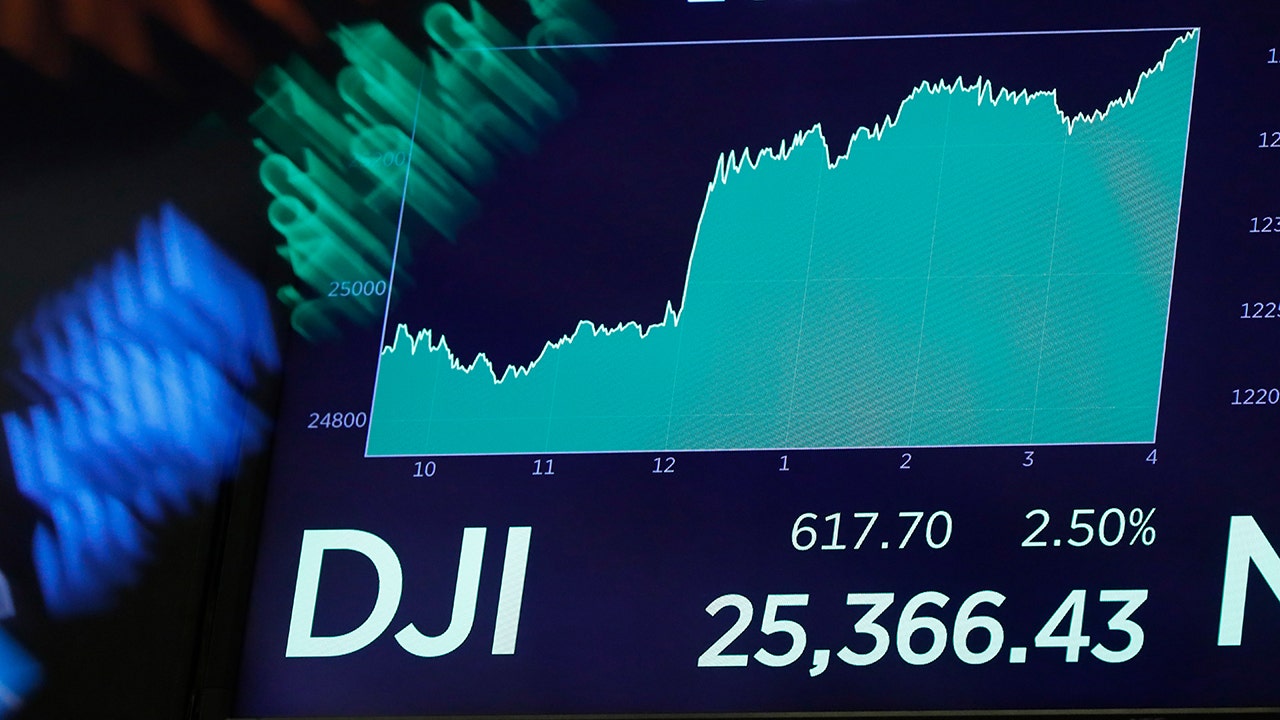
The stock market was roughly flat on Wednesday morning, with a high volume of results on the earnings front keeping major benchmarks from making big moves. Just after 11:30 a.m. EDT, the Dow Jones Industrial Average(DJINDICES:^DJI) was down 9 points to 26,647. The S&P 500(SNPINDEX:^GSPC) was up less than 1 point to 2,934, while the Nasdaq Composite(NASDAQINDEX:^IXIC) picked up 13 points to 8,134.
One of the most anticipated financial reports came from aerospace giant Boeing (NYSE:BA), which has labored under the strain of having had its 737 MAX aircraft grounded across the globe in the wake of two major fatal crashes. Meanwhile, Occidental Petroleum (NYSE:OXY) decided that it wouldn't give up on its aspirations to acquire Anadarko Petroleum (NYSE:APC), making a hostile bid in an effort to throw a wrench into Chevron's (NYSE:CVX) merger plans.
Boeing manages to hold its altitude
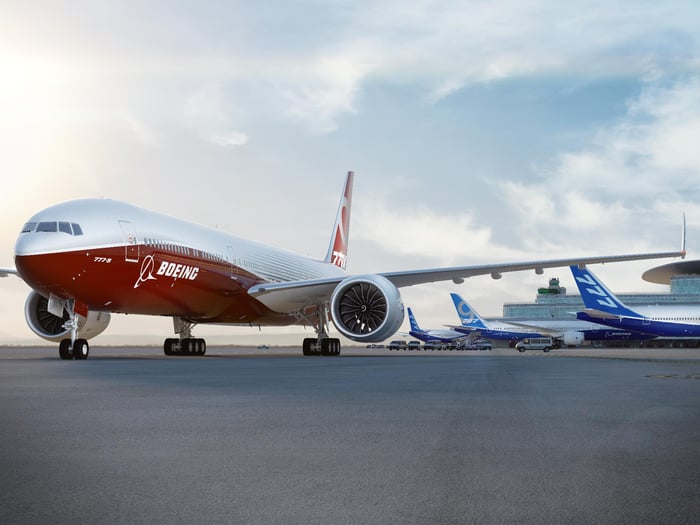
Shares of Boeing were higher by 1% after the aircraft manufacturer reported its first-quarter financial results. Boeing's numbers revealed greater exposure to the events of the past several months than many investors had expected, including a 2% year-over-year drop in revenue that helped contribute to 13% declines in both net income and core earnings per share.
Image source: Boeing.
From a financial standpoint, Boeing noted that lower deliveries of 737 aircraft than expected more than offset the upward effect of higher volume in its defense and services segments. The manufacturer did manage to deliver 149 commercial aircraft during the period, but that was down by nearly a fifth from the same period a year ago.
Yet investors seemed to take heart from a couple of developments. First, Boeing said that it's "making steady progress" in certifying a software update for the 737 MAX that's intended to resolve the issues that are believed to have contributed to the two recent crashes. As CEO Dennis Muilenburg explained, "We are focused on safety, returning the 737 MAX to service, and earning and re-earning the trust and confidence of customers, regulators, and the flying public." Also, backlog levels remain healthy at $487 billion, reflecting the resiliency of Boeing's order book.
Even so, some investors are concerned that Boeing chose to withhold any further guidance on financial results and suspend its stock repurchase program. Boeing's balance sheet is strong and has plenty of liquidity, but the aircraft manufacturer appears to be preparing for massive settlement payments that could force it to tap into its cash reserves.
An energy war
Shares of Occidental Petroleum dropped 3% following the energy company's decision to make a hostile bid to acquire Anadarko Petroleum. Anadarko's stock jumped 12% in the wake of the announcement as shareholders weighed the potential for a bidding war between Occidental and Chevron, which had previously made its own friendly acquisition bid.
Under the terms of the new deal, Occidental would pay $76 per share in cash and stock to Anadarko shareholders, split half and half with $38 in cash and 0.6094 shares of Occidental stock. The offer values Anadarko at roughly $38 billion, or $57 billion when you include the assumption of debt. Occidental termed its offer as a "superior proposal" to Chevron's bid, which included just $16.25 per share in cash and 0.3869 shares of Chevron stock for every Anadarko share.
Occidental CEO Vicki Hollub highlighted the complementary nature of the two companies' assets, as well as setting out the history that Occidental has had in pursuing Anadarko. The deal would create a powerhouse in the Permian Basin with the potential to reach the scale of a global energy leader.
However, industry analysts are skeptical that the hostile bid will win out. The synergies between Anadarko and Chevron are even more compelling in many investors' eyes, and that could lead to shareholders choosing Chevron even with Occidental offering a 20% premium to its rival's bid. Given the rise in Anadarko's stock above the value of the Chevron bid, though, at least some shareholders are hoping for a bidding war to erupt that could boost their profits from an eventual deal even further.
U.S. stocks traded in a tight range Wednesday, following record-setting gains the day before, on mixed quarterly reports and concerns about the strength of the global economy. The Nasdaq Composite hit an intra-day record high and was on track for its second straight record close.
Continue Reading Below
The declines came as investors eyed German business sentiment, which dropped in April, indicating that Europe’s biggest economy continues to weaken. Investors also gauged the possibility that Beijing may slow the pace of policy easing following a report that China's economy posted a surprisingly strong first-quarter growth.
MORE FROM FOXBUSINESS.COM ...
Corporate earnings were mixed before Wednesday's opening bell. Caterpillar reported record first-quarter results amid higher sales, results that could ease some concerns over the prospects of a global economic slowdown given the firm’s sprawling international operations. Revenue at the Deerfield, Illinois-based company rose to $13.5 billion in the three months through March, beating analyst projections. Meanwhile, profits were $1.9 billion, or $3.25 per share, higher than Wall Street anticipated.
On the other hand, Boeing earnings fell in the first quarter as the beleaguered Chicago-based manufacturer looks to overcome the fallout after one of its most popular planes was involved in two recent crashes, leading to a global halt in operations and hiatus on new orders. However, shares jumped because investors got a specific figure, $1 billion, on how much the aerospace giant's 737 Max jet crisis will cost the commpany.
AT&T shares dropped after the company reported first-quarter earnings of $4.1 billion. Adjusted earnings per share were 86 cents per share, topping analyst expectations. However, revenue was $44.83 billion, below expectations.
Advertisement
Shares of Anadarko Petroleum shot higher after Occidental Petroleum submitted a bid for the crude oil and natural gas producer that tops an offer Chevron made last week.
On Tuesday, stocks closed at an all-time high as better-than-expected quarterly profits from some of the largest companies encouraged investors. The benchmark S&P 500 index rose 17 percent, its best start to a year since 1987, while the Nasdaq has gained 22 percent, its best start since 1991. The Dow remains about half a percentage point from its record last October.
Tuesday’s move to a record high for the benchmark S&P 500 index and the Nasdaq index comes less than six months after a sharp decline in late December, which led the S&P 500 to its worst annual performance since 2008 But stocks quickly recovered in the past three months as the Federal Reserve stopped raising interest rates and the Trump administration said it was making progress on a trade deal with China.
Explanations for the record-setting session vary, but Greg McBride, Bankrate chief financial analyst, said Wednesday the Federal Reserve's capitulation on rate hikes is key.
“Fed Chair Jerome Powell removed the barricade and opened the expressway to S&P 2930 when he first uttered the word ‘patient’ on January 4. And sure enough, investors barreled right on through, pushing the market up nearly 20 percent since," McBride said in a statement.
“The questions will be asked, 'Is now the time to get in?' or 'Is now the time to get out?' Look at the big picture -- the economy is in solid shape, the labor market is the tightest in 50 years and getting tighter, and interest rates are low. But this market is not a bargain-hunter’s paradise. Be prepared for a return of volatility and for returns to be harder-earned than what we’ve seen thus far in 2019. The stock market may have returned to record highs, but don’t neglect other parts of your portfolio. Cash currently earns more than the rate of inflation and is both a good diversifier and an attractive parking place while seeking out compelling values.”
Analysts said prospects for further equity gains appear strong.
“With the S&P and Nasdaq hitting new highs, the market recovery from the downturn at the end of last year is now complete, and despite the economic concerns, investors have clearly signaled they expect continued growth. With markets breaking out again, the likelihood of further gains is high, especially if earnings continue to come in ahead of expectations,” Brad McMillan, chief investment Officer for Commonwealth Financial Network, said.
“Many of the concerns that took markets down in the fourth quarter have faded. The Mueller report was less damaging than feared; Brexit has turned from tragedy to farce; and for all the worries about growth and corporate earnings, both seem to be beating expectations. With the passing of much of the worry, markets may be now free to keep moving higher.”
Other analysts said the pace of the current rally could signal higher volatility.
We’ve maintained that the late-2018 sell-off was overdone, and we see a compelling case for equities near these levels based on sound economic fundamentals," Ryan Detrick, senior market strategist for LPL Financial. "However, the recovery has been arguably a bit fast considering some of the reasons for the decline have yet to be resolved. We think the S&P 500 could eventually move higher and make a run at our 3,000 fair value target, but we wouldn’t be surprised to see volatility pick up over the next few months."
Crude oil prices for U.S. benchmark West Texas Intermediate (WTI) were fractionally lower at $66.25 per barrel. The slight pullback in WTI prices came after the Energy Information Agency said crude oil inventories rose by an unexpectedly large 5.5 million barrels at the end of last week.
WTI is hovering just below a 6-month high touched Tuesday on supply concerns in reaction to Monday’s announcement by the U.S. that it would end sanctions that allowed some nations to import Iranian oil. The markets were already nervous about tight supplies resulting from output cuts by OPEC, Russia and others.
The 10-year Treasury yield, which moves in the opposite direction of its price, slipped fractionally to 2.52 percent. The decline came after Ifo Institute data showed a business confidence in Germany declining more than expected in April, sliding to the lowest level since 2016, according to Dow Jones. Separately, a report indicated that confidence among French manufacturers came in lower than expected. Bond prices also got a lift from the Bank of Canada, which said the weakening outlook for domestic and global growth has caused it to put aside its bias toward raising interest rates.
China’s Shanghai Composite closed up 0.09 percent, the Hang Seng finished off 0.53 percent and Japan’s Nikkei 225 ended down 0.27 percent.
Britain’s FTSE 100 was off 0.55 percent, France’s CAC 40 was down 0.34 percent and Germany’s DAX rose 0.66 percent.
Shares of Anadarko Petroleum (NYSE:APC) surged more than 11% by 9:45 a.m. EDT on Wednesday after rival Occidental Petroleum(NYSE:OXY) took its offer to acquire the oil company public. Occidental is bidding $76 per share in cash and stock for Anadarko, which trumps Chevron's(NYSE:CVX)$65-per-share agreement to acquire the company.
So what
Occidental Petroleum confirmed recent reports that it had been trying to acquire Anadarko Petroleum. The company made public a letter to Anadarko's board, which stated that it had presented three acquisition proposals to the company since late March, each one superior to Chevron's $65-per-share transaction. Its most recent offer was for $76 per share -- comprised of 40% cash and 60% stock -- which it made the day before Anadarko agreed to Chevron's proposal. The company reiterated that offer in a letter to Anadarko's board, though it increased the cash component to 50% of the deal's value.
Image source: Getty Images.
Occidental not only believes it's offering Anadarko a superior value but that the combination makes more compelling strategic and financial sense. For starters, Occidental thinks it can extract more value out of Anadarko's position in the Permian due to its best-in-class operations. On top of that, the combination would generate $3.5 billion in cost savings and other synergies, which is $1.5 billion more than Chevron estimates it can extract from the deal.
In addition to making its offer public, CEO Vicki Hollub went on CNBC to state Occidental Petroleum's case. She said: "We are the right acquirer for Anadarko Petroleum because we can get the most out of the shale." Hollub also downplayed analysts' perception that Anadarko was a less-than-ideal strategic fit for Occidental due to its operations in the Gulf of Mexico and offshore Africa, which better align with Chevron's portfolio. She noted that these assets only comprise 15% of the deal's value so they weren't as material as it may appear.
Now what
By taking its offer public, Occidental Petroleum made it clear that it's not giving up on its pursuit of Anadarko. That could yield one of the following potential outcomes:
Anadarko could stick with its current agreement with Chevron.
It could break off that deal and accept Occidental's bid.
Chevron could increase its offer.
Given Anadarko's rally today, investors seem to think that one of the latter two alternatives seems more likely.
Among the many tidbits of wisdom that Elon Musk dropped at a Tesla company investor event on Monday was the revelation that Lidar, a laser-based scanning technology that images objects in 3D, was “friggin’ stupid,” and that “...anyone relying on LiDAR is doomed.” It seemed a grandiose claim given how many autonomous car initiatives rely on the tech, but Cornell researchers have just backed up Musk’s predictions with a new method for self-driving cars to see the world in 3D using a pair of cheap cameras.
Being able to visualize and detect objects around a vehicle in three dimensions is crucial for autonomous cars to safely operate in a world where roads are shared with other vehicles, cyclists, and often pedestrians. As a driver, every time you turn your head to scan what’s around your car, your brain is instantly visualizing your surroundings in 3D and assessing potential hazards. Using cheap sensors to simply detect objects near a self-driving car isn’t enough. When it’s cruising down the road at 60 MPH, it needs to see what’s ahead and be able to plan for avoiding hazards.
Advertisement
That’s why you’ll often see Lidar (Light Detection and Ranging) systems perched atop autonomous vehicles. Using spinning lasers they scan a vehicle’s surroundings and generate 3D images of objects near and far, allowing the software to analyze the results and pinpoint things to avoid. Lidar’s expensive, though, often adding $10,000 worth of components to a car’s price tag, and it needs to be perched atop a vehicle for the best vantage point. In a time when we’re trying to maximize the range of both gas and electric vehicles, a Lidar upgrade adds a lot of drag to a car’s aerodynamics and its performance.
In a paper that will be presented at the 2019 Conference on Computer Vision and Pattern Recognition in June, Pseudo-LiDAR from Visual Depth Estimation: Bridging the Gap in 3D Object Detection for Autonomous Driving, Cornell researchers detail a potential breakthrough for autonomous vehicles. Cameras have typically been considered an inferior technology to Lidar given that they’re often installed at low angles, near a vehicle’s bumper, resulting in images that tend to distort objects in the distance which confuses neural networks trying to process and interpret the data.
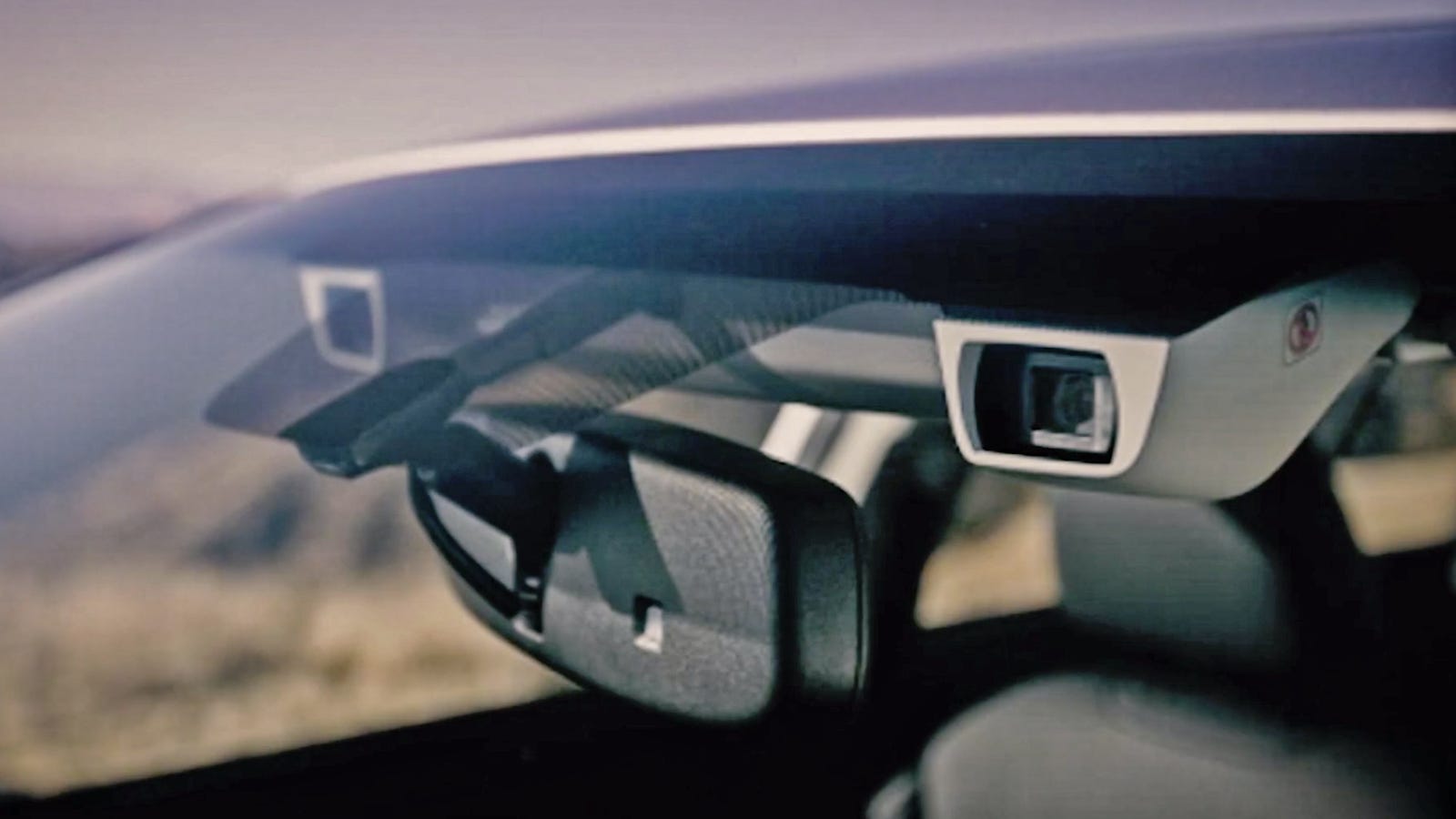
But by placing a pair of cheap cameras on either side of a vehicle behind its windshield, stereoscopic images are produced which can be converted to 3D data. Because the images are being generated from a higher vantage point, closer to where Lidar systems are typically installed, the 3D data that was generated from the cameras was found to be nearly as precise as what laser scanners are able to generate, without distortion, and at a fraction of the cost.
Advertisement
It will probably be a long time before this research makes its way into self-driving vehicles, however. Lidar is still reliable and incredibly accurate, and companies working on autonomous vehicles are more concerned about safety and liabilities at the moment, instead of costs. But as the technologies improve, the software improves, and restrictions limiting where and when autonomous cars can roam are lifted, self-driving will soon be a big selling point for consumers buying new vehicles—and they do care about costs. Cornell’s approach will make it much cheaper to implement self-driving features on a car, and it could eventually make Lidar obsolete. So maybe Musk was right?
At Tesla’s “Autonomy Day” event for investors on Monday, Elon Musk was full of trash talk for his competitors and their technology.
LIDAR, the light beam sensor that practically everyone views as an essential ingredient for self-driving cars, is “a fool’s errand,” according to Musk. What’s more, he went on, “anyone relying on LIDAR is doomed. Doomed. Expensive sensors that are unnecessary. It’s like having a whole bunch of expensive appendices... you’ll see.”
The simulation programs engineers use to run their virtual self-driving cars through millions of “edge case” scenarios to rack up billions of driving miles are good but not good enough, Musk said. “We have quite a good simulation, too, but it just does not capture the long tail of weird things that happen in the real world.”
High-precision GPS maps for self-driving cars are a “really bad idea,” according to Musk, resulting in a “system [that] becomes extremely brittle” by being too dependent and not being able to adapt.
Also, Tesla will have its Level 5 autonomous vehicles that can drive anywhere, under any condition, ready to go by 2020, according to Musk. No geographic constraints. And not just a handful of vehicles, either. “A year from now, we’ll have over a million cars with full self-driving, software, everything,” he said.
For those who have been watching Musk make wild predictions for over a decade, Monday’s event wasn’t all that surprising. After all, this is the guy who tried to turn his factory into an “alien dreadnought” of car-building robots. But the degree to which he seemed to enjoy knocking down the central pillars of the self-driving industry was truly astonishing, and it has many in the industry puzzling over how he can possibly deliver on his promises.
Musk has long argued that Tesla’s self-driving advantage comes from having a large fleet of vehicles — around 425,000 — already on the road. Those cars record situations and provide training data to improve the neural networks needed for self-driving cars. The company’s approach to autonomous vehicles is primarily focused on computer vision, or using cameras — just like humans — to recognize and understand the world.
Practically every other company trying to bring self-driving cars to the road — including Ford, Uber, Waymo, and GM Cruise — relies on a suite of sensors comprised of LIDAR, cameras, and radar. These companies argue that LIDAR can do things that cameras and radar cannot, while also providing overlapping capabilities to the things those sensors can do. These capabilities, known as redundancies, are extremely important for fully driverless vehicles as they provide an important backstop in the event of a failure.
Musk’s argument about LIDAR being useless with cameras because it replicates the visible light spectrum is “just wrong,” says Sam Abuelsamid, a senior analyst at Navigant, a technology consultancy. The human eye will respond to wavelengths from about 380 to 740 nanometers, while LIDAR can respond to the higher range of 905 to 1,550 nanometers. And new types of LIDAR, like the continuous beam FM sensor from Blackmore, can instantaneously measure velocity while also reducing computational latency, Abuelsamid notes. Layering sensors with different capabilities, rather than just relying on a purely vision-based system, is “ultimately a safer and more robust solution,” he said.
The Tesla CEO has been very outspoken and critical of LIDAR usage for autonomy, going as far as calling it “lame” at Monday’s event. “In cars, it’s freaking stupid,” Musk said. “It’s expensive and unnecessary. And as [Tesla AI director] Andrej [Karpathy] was saying, once you solve vision, it’s worthless. So you have expensive hardware that is worthless on the car.”
LIDAR can be incredibly expensive, and it’s a costly bet for most companies. They can make the job of selling self-driving cars to customers practically impossible thanks to the added costs. But companies that use LIDAR are already working on reducing those costs. Waymo began manufacturing its own cheaper LIDAR sensors in 2011. At the time, Waymo said it could lower the unit price from $75,000 for an off-the-shelf LIDAR sensor to just $7,500 with its own custom version. Last March, the company announced that it would begin selling its smallest LIDAR to third parties.
Investors who attended Tesla’s Autonomy Day event weren’t impressed by Musk’s anti-LIDAR tirade. “We continue to believe that Lidar is a good complement for cameras, radar, and ultrasonic sensors, and that the ultimate Level 5 winners are combining all of these sensors using sensor fusion,” Cowen’s Jeffrey Osborne wrote in a note on Tuesday. “Tesla’s rejection of the technology as a ‘fool’s errand’ due to the currently high additional expense is likely penny-wise but pound foolish, especially since Lidar prices continue to drop.”
Musk wasn’t as dismissive of simulation programs as he was of LIDAR, but he did claim that even the most sophisticated simulations fail to capture the ultimate “weirdness” of the real world. “If the simulation fully captured the real world, well, I mean that would prove that we’re living in a simulation, I think,” he said, harkening back to his comments at Recode’s Code Conference in 2016. “It doesn’t. I wish.”
His comments seemed targeted at Waymo, the company most see as having the lead in the race to make fully driverless cars. Waymo is big on simulation. It often touts how its Carcraft system has driven 7 billion miles in simulation, compared to 10 million miles on public roads as of last October. Musk argues that simulations are insufficiently weird to capture actual driving, which means Waymo won’t be able to catch up to all of the miles Tesla vehicles have driven with a simulation.
When asked for comment, a Waymo spokesperson referred to the company’s past statement on the importance of simulation: “One of the key advantages of simulation is that you can focus on the most interesting interactions — flashing yellow signals, wrong-way drivers, or nimble pedestrians and cyclists — rather than monotonous highway miles.”
Musk also criticized the practice of using high-definition maps to help guide self-driving cars through an environment. Before it deploys any vehicles in a city or town, Waymo first builds a detailed picture of that area and categorizes “interesting features,” like driveways, fire hydrants, and intersections. By knowing what the “permanent features of the road,” Waymo’s sensors can focus on moving objects like other vehicles and pedestrians.
According to Abuelsamid, the benefit of high-definition maps comes from being able to precisely localize the car in its environment by triangulating the distance from known objects. HD maps also contain data about the rules of the road, like the speed limit or which lanes you can turn from. This narrows down the area that must be scanned by the car’s perception system, and allows those sensors to focus on what’s most important: pedestrians and other cars on the road.
The biggest shock came when Musk stated unequivocally that Tesla would have “a million” driverless cars on the road by the end of 2020. The plan is for them to operate commercially in a ride-hailing network. When asked if these cars would be “Level 5 without a geofence,” meaning they could travel anywhere, under any conditions, without a human behind the wheel, Musk said yes.
Some analysts walked away with the impression that the robotaxi idea was underdeveloped, or “half-baked,” Cowen’s Osborne wrote. Some experts doubt that there can ever be a true Level 5 autonomous vehicle. As such, the vast majority of engineers in the AV industry are trying to perfect Level 4 autonomous driving, which requires zero input from a human driver, but only in a specific geographic area or under specific conditions (like good weather).
“For the foreseeable future (if not always) cars or other mobility devices will need to function under a set of engineering constraints,” says Bryan Reimer, a top research scientist at MIT’s Center for Transportation and Logistics. He noted that what the industry is working towards now is expanding the geographic domain for Level 4 vehicles, not the “unconstrained Level 5 problem.”
Reimer said that any engineering team working under a “reasonably adept regulatory authority” would not develop systems that drive in conditions that do not permit safe mobility, like blizzards or hurricanes. Musk suggested that his cars will be able to function under any scenario, no matter the danger.
Never mind the fact that the rest of the industry disagrees. At a tech conference last year, Waymo CEO John Krafcik said that “autonomy will always have constraints,” which was a sobering admission from the head of the leading driverless car company. Others have made similar comments about reining in expectations. “We overestimated the arrival of autonomous vehicles,” Ford CEO Jim Hackett said earlier this month.
It’s almost as if the entire industry was trying to make amends for all of the hype and cash that has been dumped in this space over the past few years. Everyone except for Musk, that is.
“While Tesla will certainly continue to introduce better assisted driving features over the coming years, true autonomy is a completely different game altogether and requires a completely different approach,” said Austin Russell, CEO of LIDAR maker Luminar. “There’s no longer a backup driver, hands on the wheel, taking over when things frequently go awry. No doubt it will get [twice, three times] or maybe even [10 times] better over the vehicle’s life cycle. But for autonomy, it has to be, quite literally, near perfect ... to achieve safety greater than that of the average human driver.”
The argument could be made (and it has been made in the comments section of previous Verge articles about Tesla) that Waymo and other AV firms need to battle it out with upstarts like Musk in order to produce the best outcome for us, the customers. If Waymo is the only game in town, we’ll all probably pay more for rides and be subjected to a lot of forced Google tie-ins, ads, and data sharing about our movements. With Tesla (and Ford and GM) in the mix, Google will be forced to move faster and behave better.
Another way of looking at it, though, is that by bucking the rules of what is safe in self-driving cars and what isn’t, Musk is putting people in danger right now. According to a new poll, 71 percent of drivers across the world think they can buy a driverless car today. They cannot, of course, but they think they can because some carmakers are designing and marketing vehicles in such a way that drivers believe they can relinquish control. Tesla has been criticized for selling a “Full Self Driving” option that misrepresents what its vehicles are capable of doing.
Musk wants to gain a competitive edge by referring to Tesla as “full self-driving” vehicles, but he is fueling consumer confusion. And a confused driver can be worse than no driver at all.
Ford is investing $500 million in the electric vehicle startup Rivian, and will sell a vehicle built on the company’s platform in the coming years, the companies announced Wednesday.
Rivian unveiled its own all-electric pickup and SUV models at the Los Angeles Auto Show in November with plans to put them into production late next year at its factory in Normal, Ill. At the time, the company said it was open to licensing the technology to other brands.
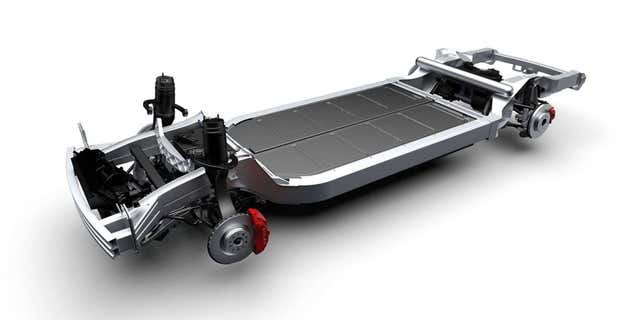
Both models are built on a shared “skateboard” style chassis that incorporates the drivetrain and battery pack and can be modified to accommodate a variety of body types.
Rivian recently completed a $700 million investment round led by Amazon and was reportedly in discussions with General Motors to create a similar partnership to the one being forged with Ford.
Ford CEO Jim Hackett did not reveal the type of vehicle that will be created, or when it will go on sale, but confirmed that it will be in addition to the electric Mustang-inspired SUV and Ford F-150 the automaker currently has in development.
“There’s a lot we can learn from Rivian’s clean sheet approach,” said Ford President Joe Hinrichs.
Rivian’s first two models feature four electric motors, air suspension systems and promise a per-charge range as high as 400 miles. Both are aimed at the premium segment and are expected to start at $69,000.
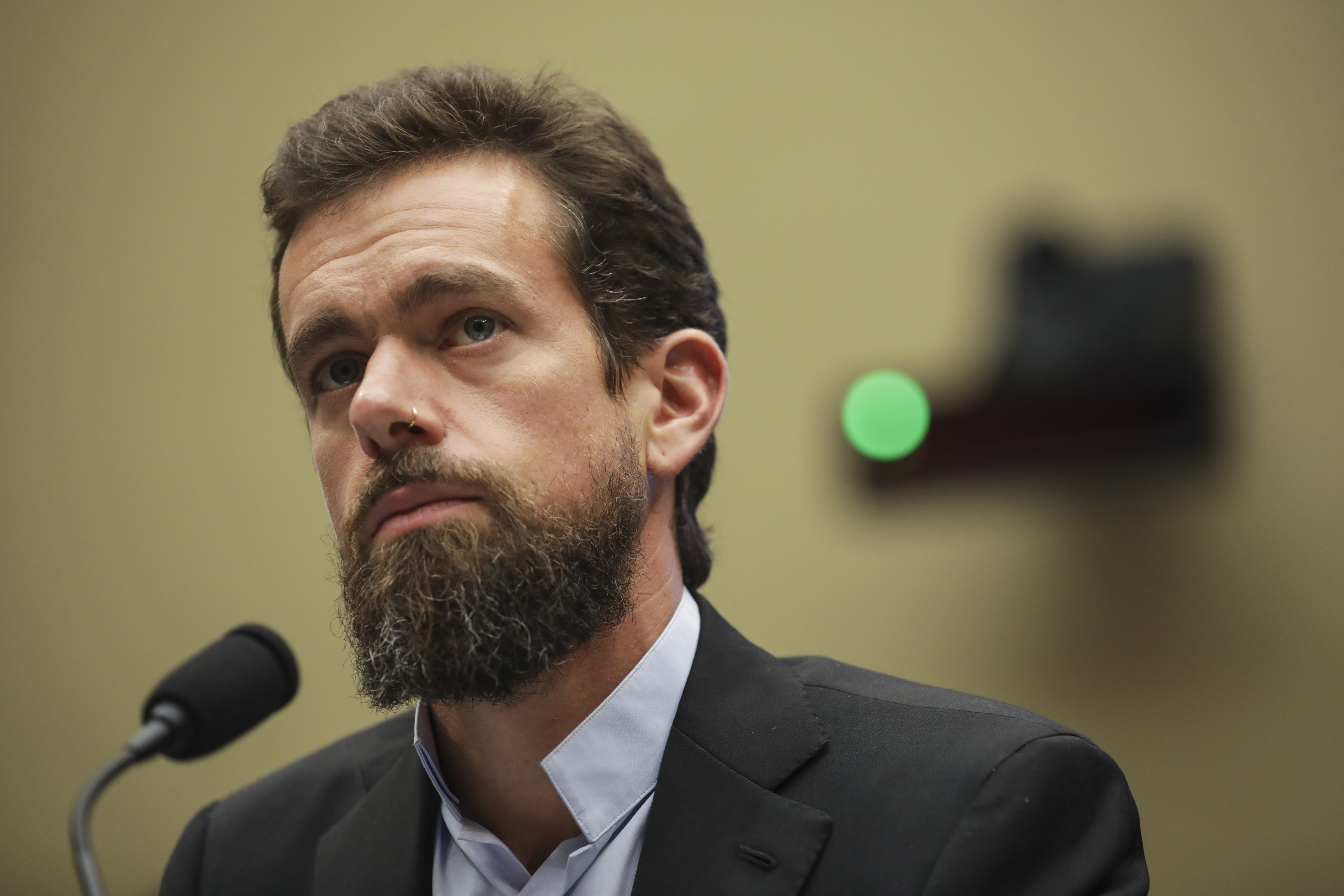
President Donald Trump is completely hung up on his Twitter follower count. And he let the social media giant’s CEO know it.
According to a Washington Post report, Trump spent much of Tuesday’s meeting with Twitter’s Jack Dorsey, among others, complaining that the site was artificially deflating how many followers he has.
Dorsey reportedly tried to soothe the President, telling him that fluctuating follower counts often indicate Twitter’s attempt to purge bots or fake accounts from the site.
Donald Trump Jr. has also trumpeted his fears about “shadow-banning,” a term for social media platforms allegedly suppressing conservative voices. The platforms have insisted on their impartiality in the face of the accusations.


/cdn.vox-cdn.com/uploads/chorus_image/image/63664203/elon_musk_tesla_3225.0.jpg)
:format(webp):no_upscale()/cdn.vox-cdn.com/uploads/chorus_asset/file/13601827/vpavic_181127_3122_0015.jpg)
:format(webp):no_upscale()/cdn.vox-cdn.com/uploads/chorus_asset/file/16183257/Tesla_Full_Self_Driving_Computer_2040.jpg)
:format(webp):no_upscale()/cdn.vox-cdn.com/uploads/chorus_asset/file/15963757/tesla_model_y_3543.jpg)